
Smart Home Meets Digital Healthcare
At the Home Assistant Community Day, USTP’s Digital Healthcare programme showed how students develop health technologies in practice
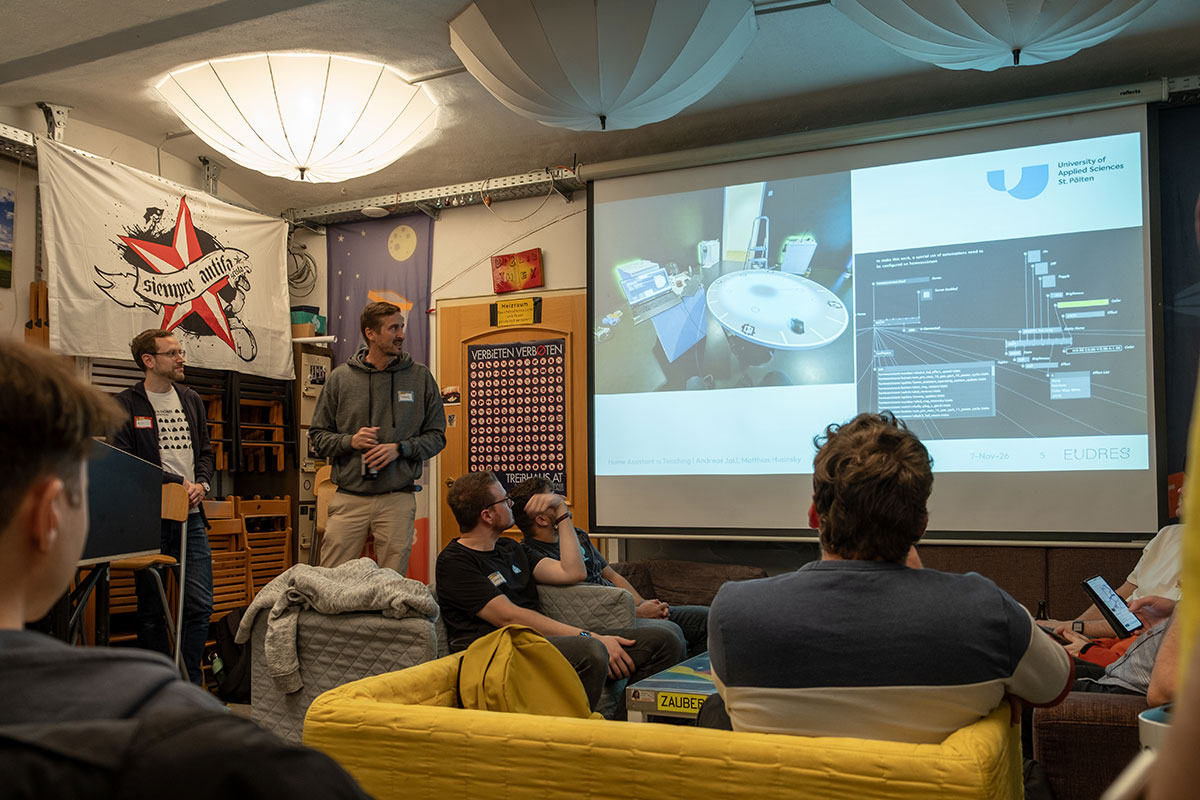
How can smart home technologies be used to improve health and wellbeing at home? The students of the study programme Digital Healthcare work on this question from a practice-oriented perspective: They develop their own sensors, build prototypes, and integrate them into the open-source platform Home Assistant.
Lecturers Andreas Jakl and Matthias Husinsky provided insights into this teaching approach at the global Home Assistant Community Day. In the event’s Viennese edition, their presentation “Home Assistant in Teaching” used four selected projects to demonstrate how students build their own smart home prototypes at home. The audience included representatives of the Home Assistant community and the Open Home Foundation which is behind the platform’s further development.
From Sensors to Visualisation
Over the course of a semester, the students form teams to develop their own smart home prototypes with direct reference to health and wellbeing. They do this by going through the entire process from sensor to application: Each team develops its own sensor using an ESP32 microcontroller, produces a case for it through 3D print, and finally integrates the prototype into Home Assistant.
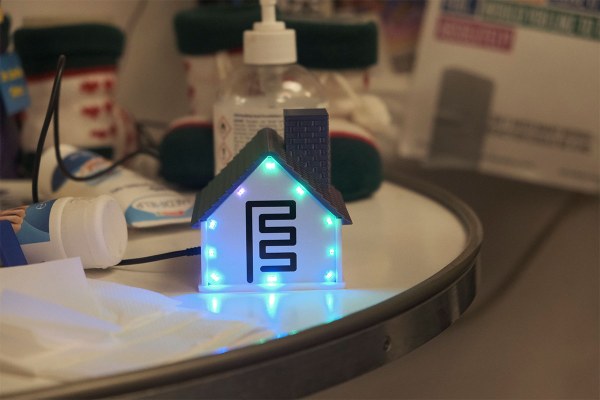 Copyright: Victoria Leskoschek
This results in, for example, applications for reminders, dashboards, or automated processes in the home. To carry out the project, each team is given its own kit containing a Raspberry Pi, a router, and various smart home sensors.
“Our aim in teaching is to give students a hands-on experience of the entire process, from sensors right through to visualisations. By working on their own prototypes, they learn how sensors, self-built devices, and a central data platform interact. And the results are not confined to the screen: Light, movement, and sound make the feedback perceptible in everyday life”, explains Andreas Jakl.
Smart Assistants for Everyday Life
Two exemplary student projects demonstrate what such applications can look like: The “Hydration Station” by Chahed Rajoub and Nina Hubeny uses the weight of a water bottle to tell how much a person has drunk, and an LED ring provides feedback in colour. On hot days, the system will use Home Assistant to remind the person to drink more frequently.
“AirTree“ by Tanja Elsner, Jasmin Pfleger, and Sabrina Matschitsch renders air quality visible using a 3D-printed tree. If the measured CO2 level exceeds a defined threshold, a leaf starts to droop and red LEDs light up. In addition, Home Assistant sends a message as a reminder to open a window.
Exchange with the Home Assistant Community
The Home Assistant Community Day brought together users, developers, and other interested members of the community. “It was particularly valuable for us to present our teaching approach to a specialist audience and to receive feedback from people who use and help develop Home Assistant themselves. This exchange also provides us with new ideas for further developing the course”, explains Matthias Husinsky.

FH-Prof. Andreas Jakl , MSc
Deputy Academic Director Digital Healthcare (MA) Lecturer Member of the UAS Board from 2023 to 2026 Department of Media and Digital Technologies
