
From Research to Application: AI in the Real World
Social Artificial Intelligence Night (SAINT) 2026 at USTP Brings together Science, Industry, and AI Enthusiasts
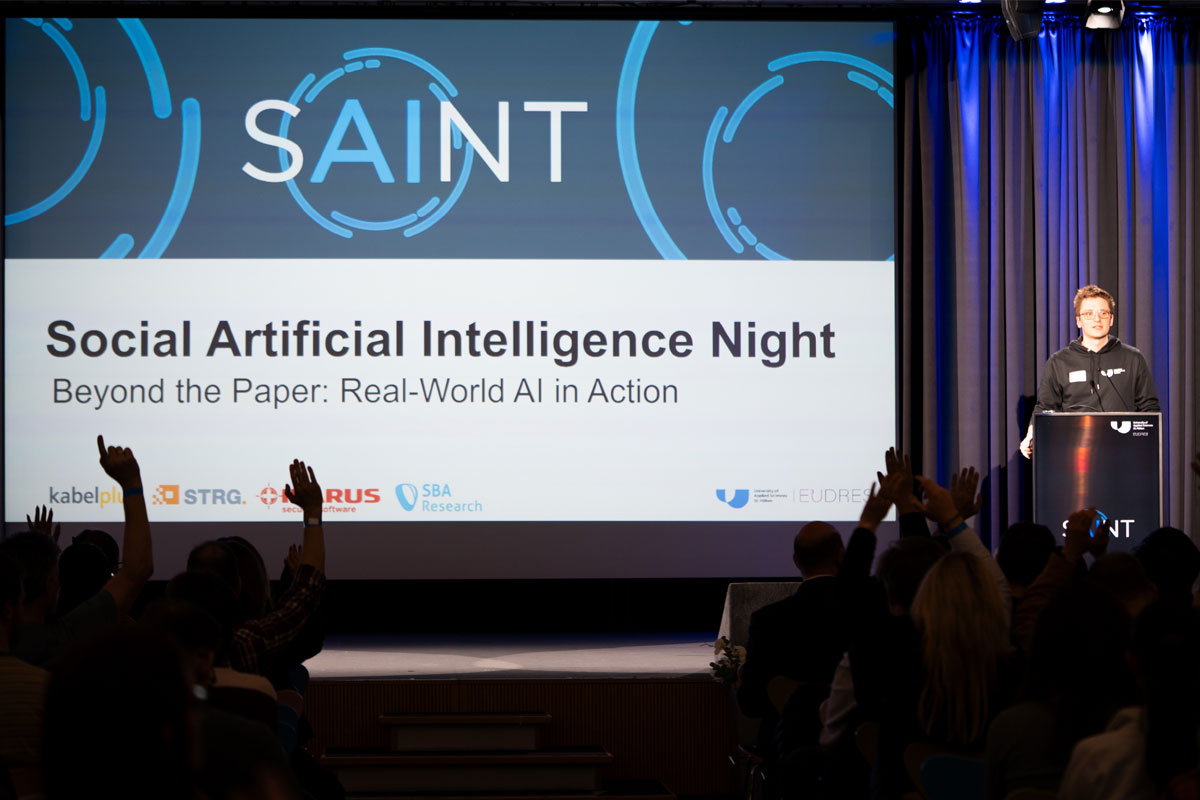
Under the motto "Beyond the Paper: Real-World AI in Action”, this year’s Social Artificial Intelligence Night (SAINT) at USTP – University of Applied Sciences St. Pölten showed how artificial intelligence finds its way from research into real-world applications. The symposium of the Department of Computer Science & Security brought representatives of science and industry as well as AI enthusiasts together to discuss current projects, possible practical applications, and societal questions in the context of AI. The SAINT offers an important platform for exchange between research, business, and the AI community in Austria.
Small Model, Big Impact: The New Era of Efficient AI
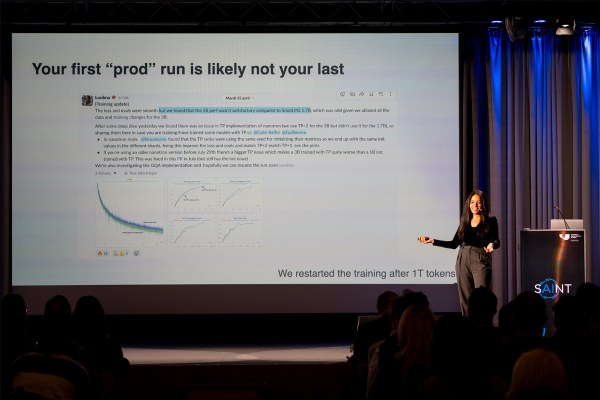
One highlight of this year’s SAINT was the keynote by Loubna Ben Allal, Machine Learning Engineer at Hugging Face, the leading platform for the free exchange of AI language models. In her presentation of “SmoILM Training Playbook“, she provided fascinating insights into the latest developments in the efficient training of large language models (LLMs) and shared exclusive findings from the conception and training of “SmolLM3” – a compact, resource-saving language model that allows for high-performance AI applications despite its small size.
 Copyright: Tobias Kietreiber
Loubna Ben Allal emphasised the continued importance of small, efficient models within modern AI systems and pointed out that these are indispensable for daily tasks and resource-saving applications in particular.
“Small, efficient models will most likely remain indispensable. Even in systems based on large, highly developed models, there is still a need for smaller models used for routine tasks: summarising documents, classifying texts, or forwarding requests. And companies that have to operate models directly on devices for security and data privacy reasons will have to rely on cost-efficient models”, explains the project manager of “SmolLM 3” and expert for model efficiency, open-source tools, and responsible AI development.
When it comes to the development of AI systems, Loubna Ben Allal also perceives a clearly different approach now than a few years ago: “Three years ago, training a model from the ground up was often the only way if you wanted to adapt it to your own needs. Today, this is no longer where I would begin for most applications. Rather, I would fine-tune an existing model and spend a considerably larger portion of my budget on data quality and evaluation. The open-source ecosystem has matured enormously: By now, there are high-performance models for almost every scale.”
Focus on Efficient and Transparent AI Solutions that Conform to the Law
The varied programme provided insights into the diverse fields of application for artificial intelligence: from automated product identification in food production through specialised AI models offering legal security and supporting digital sovereignty to systems that actually understand the reasons for their results rather than just make predictions. Moreover, it was demonstrated how AI can automatically be designed in a way that conforms to the law by translating regulations such as the EU AI Act and the GDPR into clear rules.
“With the SAINT, we create a space where experts and interested persons experience and discuss new AI developments and gain valuable impulses for innovation and critical appraisal based on concrete practical examples”, explains Sebastian Eresheim, Researcher at USTP’s Institute of IT Security Research and organiser of the event. “I am particularly pleased that I get to watch every year as persons from entirely different disciplines and companies engage in networking.”
New AI Living Lab for Teaching, Research, and Dialogue with Business and Society
“At USTP, we are actively involved in shaping the future of trustworthy, transparent, sustainable, and human-centred AI. To this end, we combine cutting-edge research and practically relevant application and training”, stresses USTP CEO Johann Haag.
The opening of the new AI Living Lab at USTP in the run-up to the SAINT attests to this commitment. The Lab connects infrastructure, expertise, and demonstration – with the goal of designing the future of AI together.
“Developing and practically testing AI methods under real-life conditions requires a flexible, powerful, and scalable infrastructure. Furthermore, the increasing integration of AI technologies into work processes and our everyday lives makes it necessary for users to be involved in the development process in order to train applications holistically and to ensure high acceptance”, says Marlies Temper, Academic Director of the study programmes Data Intelligence (master) and Data Science and Artificial Intelligence (bachelor) at USTP.
However, the new AI Living Lab is not intended only for research and teaching. As an open space for encounter, it strengthens the dialogue between science, business, and public. This is where students, researchers, and company partners are to develop innovative AI solutions together.
Further Information
- Read more about the Social Artificial Intelligence Night (SAINT)
- More info on the opening of the new AI Living Lab
Dipl.-Ing. Sebastian Eresheim , BSc
Researcher Institute of IT Security Research Department of Computer Science and Security
FH-Prof. Dipl.-Ing. Mag. Marlies Temper , Bakk.
Academic Director Data Intelligence (MA) Academic Director Data Science and Artificial Intelligence (BA) Deputy Head of Department Continuing Education Officer Department for Computer Science and Security Member of the UAS Board from 2023 to 2026 Department of Computer Science and Security
Sandra Lagler , BA, MA
Expert Video Production und Corporate CommunicationsMarketing and Communications
