
Digital Product Passports in Practice
USTP Supports Industry with Expertise and Applied Research
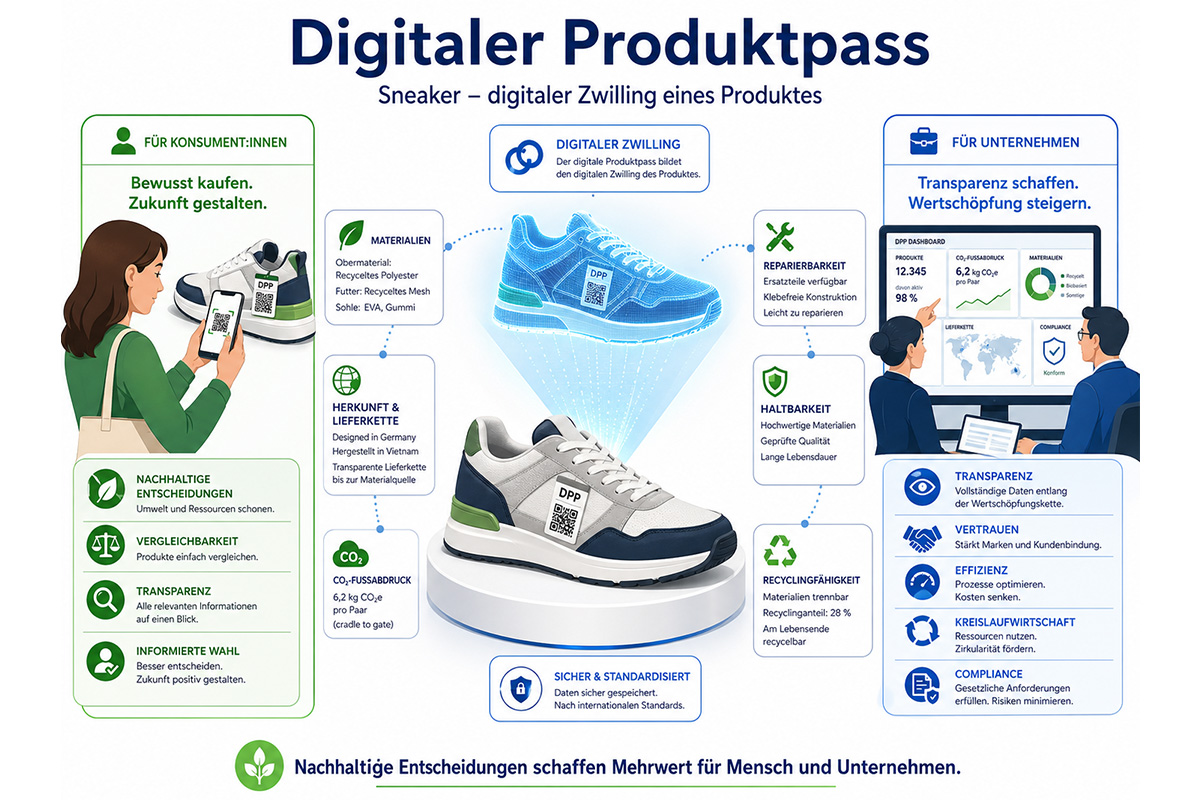
Over the past few years, the Institute for Innovation Systems at USTP – University of Applied Sciences St. Pölten asserted itself as a competent research partner, orientation guide, and hub for knowledge transfer with regard to the digital product passport (DPP). The institute’s extensive know-how and research findings from multiple projects are now directly integrated into the counselling and support of manufacturing companies.
The Digital Product Passport (DPP) is one of the central instruments of the European Union on the path towards achieving a sustainable circular economy. The DPP bundles product-related information – the materials’ origin and the product’s composition as well as repair and recycling options – and makes it electronically accessible for companies, authorities, and consumers. For manufacturing companies, however, this comes with considerable technical, legal, and organisational adjustments.
USTP – University of Applied Sciences St. Pölten has been scientifically accompanying this development for several years: In a baseline study and three research projects building on it, USTP’s Institute for Innovations Systems explores how digital product passports can be designed from a technically, organisationally, legally, and economically meaningful point of view and integrated into practice. In doing so, the researchers worked out application scenarios for several sectors and developed concrete prototypes, among other tasks. The combined expertise is now available for manufacturing companies.
“The digital product passport is no longer a distant regulatory project – rather, it is a reality for manufacturing companies here and now. We systematically developed knowledge over the past years which we are now using specifically to accompany companies on this path”, explains Tassilo Pellegrini, Head of the Institute for Innovation Systems at USTP.
DPP4E(lectronics): Focus on SMEs and Data Infrastructure
In the project DPP4E, researchers are developing a DPP prototype for the electronics sector and testing it under near real-life conditions. A special focus is on small and medium-sized businesses (SMEs) because these tend to have limited technical and personnel resources to spend on DPP implementation. The project consortium includes several company partners and the University for Continuing Education Krems. DPP4E continues until September 2026.
ECO-TCO: From Product Passport to Economic Application
Together with the company Siemens, the project ECO-TCO explores how data from a DPP can be used for ecologically sustainable product configuration. The objective is to enable companies to compare their products using ESG criteria (environmental, social, governance) and total-cost-of-ownership parameters and to optimise them – thus proactively meeting regulatory requirements. The project is ongoing until March 2027.
DPP4Plastics: Transparency as the Basis for High-Quality Recycling
The project DPP4Plastics examined the specific requirements of DPP for plastics manufacturing and processing companies. The focus was on new documentation obligations, the protection of business secrets, and the potentials of a DPP for a circular plastics economy. The project was executed in cooperation with the Transfercenter für Kunststofftechnik (TCKT) and the law firm Höhne, In der Maur & Partner.
DPP4ALL: Scientific Basis
The exploratory study DPP4ALL formed the starting point for the research activities as it analysed the technical, legal, and organisational preconditions for digital product passports for the first time. Potential fields for application were identified based on document analyses, expert interviews, an Austria-wide consumer survey, and focus groups involving stakeholders.
Online Gallery: Interim Results Publicly Accessible
Interested companies and experts can gain a direct impression of the research work: The Institute for Innovations Systems operates a publicly accessible online gallery containing interim results, demonstrators, and prototypes from both completed and ongoing projects.
The gallery can be reached at iis-ustp-demos.fly.dev.
All four research projects received funding from the Austrian Research Promotion Agency (FFG) and were implemented in cooperation with partner companies.

FH-Prof. Mag. Dr. Tassilo Pellegrini
Head of Research InstituteInstitute for Innovation Systems Department of Digital Business and Innovation
