Healthier Working Thanks to new Ergonomics App
Growing Research Focus for Gait Analysis Using AI at USTP
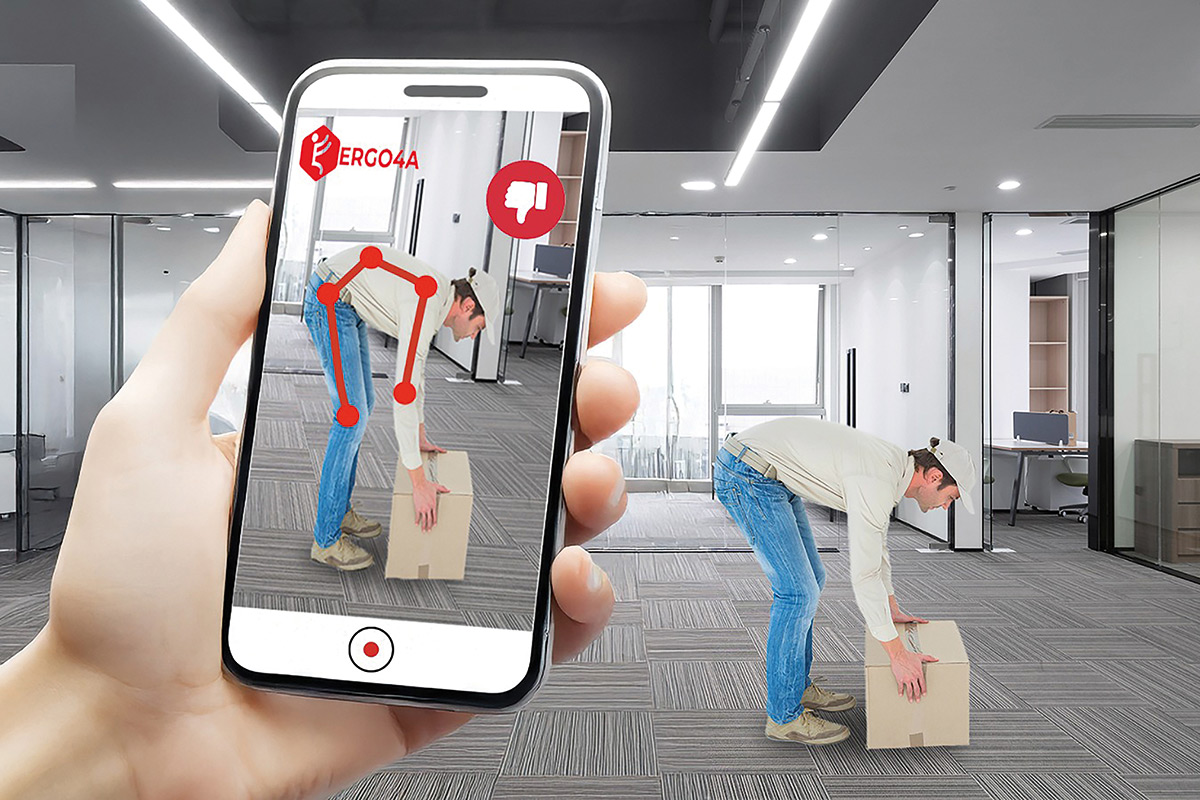
A new app of USTP – University of Applied Sciences St. Pölten makes it possible to analyse and improve work routines directly on the smartphone. The application developed in the project “Ergo4All” in cooperation with TU Wien is based on modern image processing and artificial intelligence. It is part of a growing research focus at USTP that is dedicated to markerless movement tracking and biomechanical analysis outside of laboratories – with applications ranging from work to rehabilitation.
Work-related conditions of the locomotor system are among the most frequent reasons for sick leave throughout the EU. At the same time, however, traditional ergonomic analyses tend to be complicated, cost-intensive, or only partially accessible. For this reason, it is key to design work processes in such a way that employees’ health is preserved in the long term, and to integrate complex movement analysis into everyday life without expensive lab equipment. USTP – University of Applied Sciences St. Pölten is currently conducting research into this.
A recent example of the successful implementation of such research is the completed project Ergo4All – Ergonomics for All realised in cooperation with TU Wien (under the lead of David Kostolani). The outcome is a mobile app that makes it possible to easily and independently analyse and optimise work processes based on certain ergonomic criteria.
 Copyright: Christoph Böhm
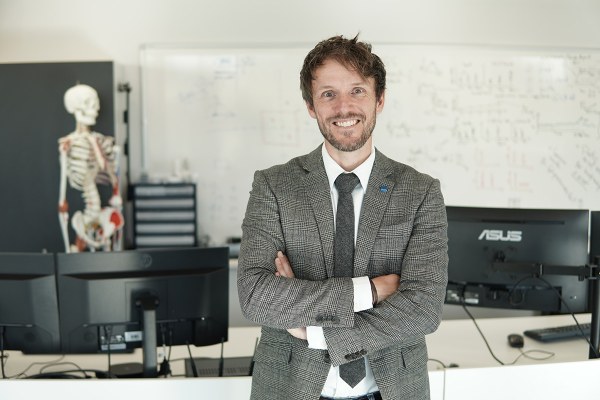
“Thanks to technologies such as AI and computer vision, we can increasingly implement processes on a simple smartphone that – for decades – used to require labs with expensive motion capture systems. In this way, we can take biomechanical movement analysis where it is needed: directly to the people. This gives us completely new opportunities in terms of disease prevention, rehabilitation, and health promotion”, emphasises Brian Horsak, Head of USTP’s Center for Digital Health and Social Innovation.
Ergonomics via Smartphone
The developed app uses modern methods of machine vision and artificial intelligence to capture and analyse body postures directly on the smartphone – without any additional sensors involved. Users film themselves during an activity and can analyse their movements in real time, save the video, and systematically improve patterns. The technical analysis is complemented by easy-to-understand visualisations and tips pointing out concrete improvement potentials in everyday work processes.
“With the app we have developed, we want to support safety officers and occupational physicians in their daily practice and facilitate the dialogue with employees about ergonomic working conditions. The quick applicability and user-friendly presentation of results have proved their worth as helpful first steps (ice breakers). We have thus succeeded in raising the awareness for ergonomic topics in the long term”, says Christian Jandl, Head of Research Group at USTP’s Institute of Creative\Media/Technologies.
High Priority for Data Protection
A central aspect of development is the protection of privacy – the entire processing takes place directly on the smartphone without the use of external AI servers. Personal and company-related data thus remains completely private.
Understanding Movement – outside the Lab
The app is part of a growing research focus at USTP, particularly at the Center for Digital Health and Social Innovation (CDHSI). The central question is how biomechanical movement analysis can be reliably used outside specialised labs as well. Computer vision is used to this end – technologies that allow computers to recognise, analyse, and interpret visual information from images and videos.
Smartphone-Based Movement Analysis
Current projects directly tie up with this topic area:
In the project PROGRESS, a smartphone-based 3D system for the analysis of gait and movement patterns in children with cerebral palsy is being developed and validated. The researchers develop new and user-friendly motion capture systems to contribute to improved care for patients suffering from cerebral palsy. The project is ongoing until the end of 2027 together with the Orthopaedic Hospital Speising and with financing from the Austrian Science Fund (FWF).
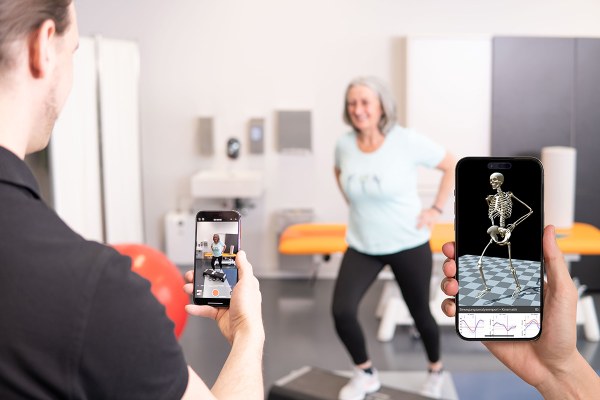
Within the framework of a nationwide citizen science study, the research team of ACCESS explored cost-effective movement analysis technologies that can be used without sophisticated lab equipment. This project also uses smartphone-based, markerless 3D movement analysis to record and analyse movement data from videos using artificial intelligence. In this way, patients with knee arthritis are to be enabled to detect clinically relevant changes early on. At the same time, a nationwide network of physiotherapists as citizen scientists is developed who collect movement data in everyday practice, thus testing the technology’s applicability under real-life conditions. The project receives funding from the Gesellschaft für Forschungsförderung NÖ (GFF) within the framework of the Lower Austrian RTI strategy 2027.
 Copyright: Florian Stix
Research with Added Value for Society
By means of the province of Lower Austria’s endowed professorship for “Applied Biomechanics in Rehabilitation Research”, a unique research focus is to be established in Austria in the long term. This is to optimise patient care through the use of innovative technologies and thus contribute to the solution of societally relevant problems. The close ties between research and teaching at USTP ensure that new insights and methods are directly integrated into courses and taught to the next generation of physiotherapists. Simultaneously, complex analytical methods from research are further developed to bring concrete benefit to people’s everyday lives – in the working world, in rehabilitation, or in disease prevention. With the Ergo4All app, this mission is already tangible.
About Ergo4All
Ergo4All was supported through means of the project fund Arbeit 4.0 of the Lower Austrian Chamber of Labour.
The app is available for Android and iOS in the respective stores.
Further Reading

Dipl.-Ing. Dr. Christian Jandl
Head ofDigital Technologies Research Group
Institute of Creative\Media/Technologies Researcher
Digital Technologies Research Group
Institute of Creative\Media/Technologies Department of Media and Digital Technologies
FH-Prof. Priv.-Doz. Dr. Brian Horsak
Head of Center for Digital Health and Social Innovation Senior Researcher Institute of Health Sciences Department of Health Sciences