Interdisciplinary, international, intercultural, innovative, and intensive: The Interdisciplinary Lab (or iLab) welcomes students
from various fields of study
with a pioneering spirit
who would like to spend a semester developing solutions to socially relevant challenges (with reference to the UN’s SDGs), thereby making a contribution to society.
Are you interested?
From concept development to the design of a prototype: Under the expert supervision of lab masters and coaches, you work in international teams on your challenges in a practical and self-organised manner. Thanks to the design thinking-based process and the unique learning approach, you acquire important and future-oriented skills.
You can complete the iLab instead of a regular semester within the framework of your mobility window.
Various Disciplines and Nations
Various Disciplines and Nations
You collaborate with students from various disciplines and diverse cultural backgrounds.
English as a Working Language
English as a Working Language
You consolidate and expand your linguistic skills in the English-language work setting.
Challenges Relevant for Society
Challenges Relevant for Society
You find solutions to complex current challenges (based on the SDGs).
Self-Organised Teams
Self-Organised Teams
You work with your team daily and in an autonomous manner.
Support from Lab Master and Coaches
Support from Lab Master and Coaches
You are accompanied and supported by professionals from the very beginning.
24/7 Offices
24/7 Offices
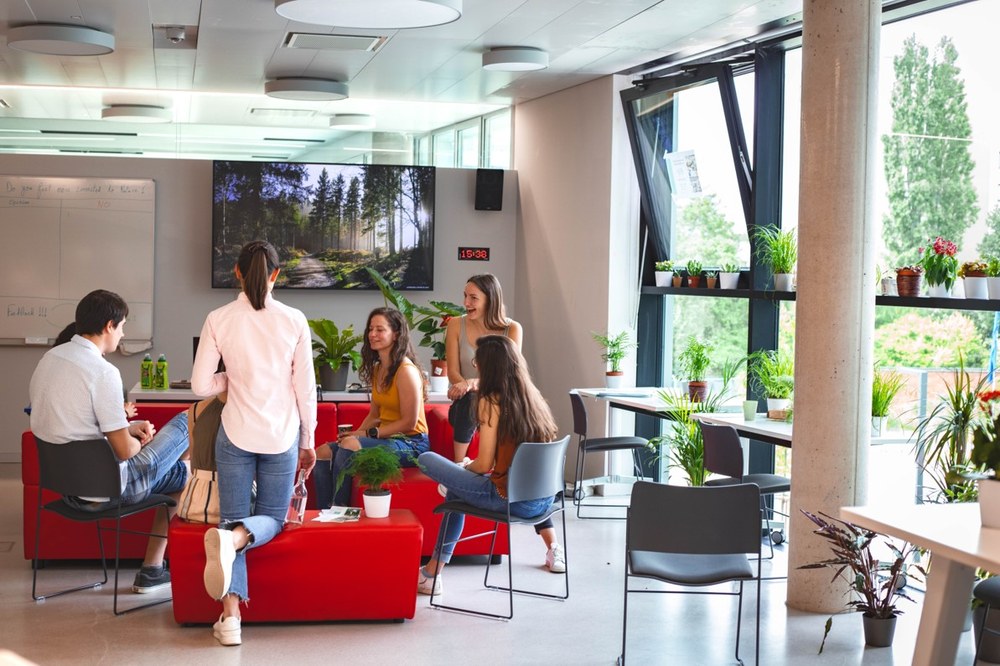
You can use designated office rooms with suitable equipment throughout the entire semester.
Future Skills
Future Skills
The real-life learning setting in the iLab allows you to acquire and strengthen important future skills.
iLab Process
From the Challenge to the Solution
Find Solutions to Current Societal Challenges!
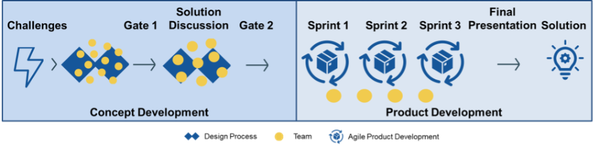
In the iLab, you are part of a human-centred design process.
You will go through two interconnected phases:
Concept Development Phase In this phase, you will explore the needs and requirements of those affected by the challenge. The goal is to uncover root causes and develop initial ideas and prototypes for possible solutions.
Product Development Phase Building on your concept, you and your team will work on a solution that is not only need-oriented, but also technically feasible, future-proof, and valuable to its users.
Two Gates on the Way to the Concept
Throughout the process, you will pass through two gates. These are key decision points where you and your team present your newly defined problem statement (Gate 1) and, later, your proposed solution and prototype (Gate 2) to a jury from various professional fields. You will receive questions and constructive feedback to refine your concept or rethink your approach.
The outcome of these gates determines which teams continue working on their challenge. After each gate, teams may be restructured to continue working on the remaining challenges.
Three Sprints – One Solution
In three sprints, the newly formed teams will develop a solution step by step. You will work with agile project management methods – such as Scrum and Kanban – and follow the principles of transparency, inspection, and adaptation.
After each sprint, a review session allows teams to present their progress, receive feedback, and use it to improve the next iteration.
At the end of the semester, all teams will showcase what they have created together – their final product.
Skills Acquisition
At the Personal Level
(Further) development of subject-specific competencies and soft skills
The iLab promotes your independence and self-management. In individual coaching sessions, work and reflect on your personal learning goals.
In heterogeneous settings and with alternating groups of persons, you train your conversation skills and reflectivity through reflective dialogues. In this context, you work on a Learning Blog that stays with you for the entire semester and that you use for highlighting both project-related and individual challenges and possible solutions in the peer setting in order to learn from them.
At the Team Level
Interdisciplinary Collaboration
In the iLab, you learn
how interdisciplinary collaboration offers added value,
how you can design this collaboration in a positive way,
and how you can profit from one another.
This is why a key focus of the iLab is on the team context. The composition of the teams is changed deliberately (after each decision gate) in order to allow the student to repeatedly go through the various team development stages. Particularly when teams are newly formed, team building measures (for example, out of doors) and tutoring are offered to help you adjust. Later in the process, feedback and coaching talks give you the opportunity to reflect on your work and find solutions to challenging situations.
At the Project Level
From Challenge to Solution
At the iLab, you work on the project level using the design thinking approach – to translate complex societal challenges into feasible solutions. In a three-day bootcamp, you will get to know the process and directly apply creative methods to your challenge.
Coaches from various departments will support you throughout the concept development phase. The process is complemented by a two-day Business Design Bootcamp and sessions on pitching and storytelling.
From Concept to Implementation
Your concept forms the foundation. Together with your team, you will develop it into a product that serves as a solution to your challenge – in three sprints.
At the beginning of the product development phase, you will define a Minimum Viable Product (MVP), which you will refine throughout the sprints.
In the Agile Project Management Bootcamp, you will acquire basic knowledge of the Scrum and Kanban frameworks – which you will then apply directly in product development and deepen with the support of the Lab Master.
Coaches from various fields will help you reach your goal.
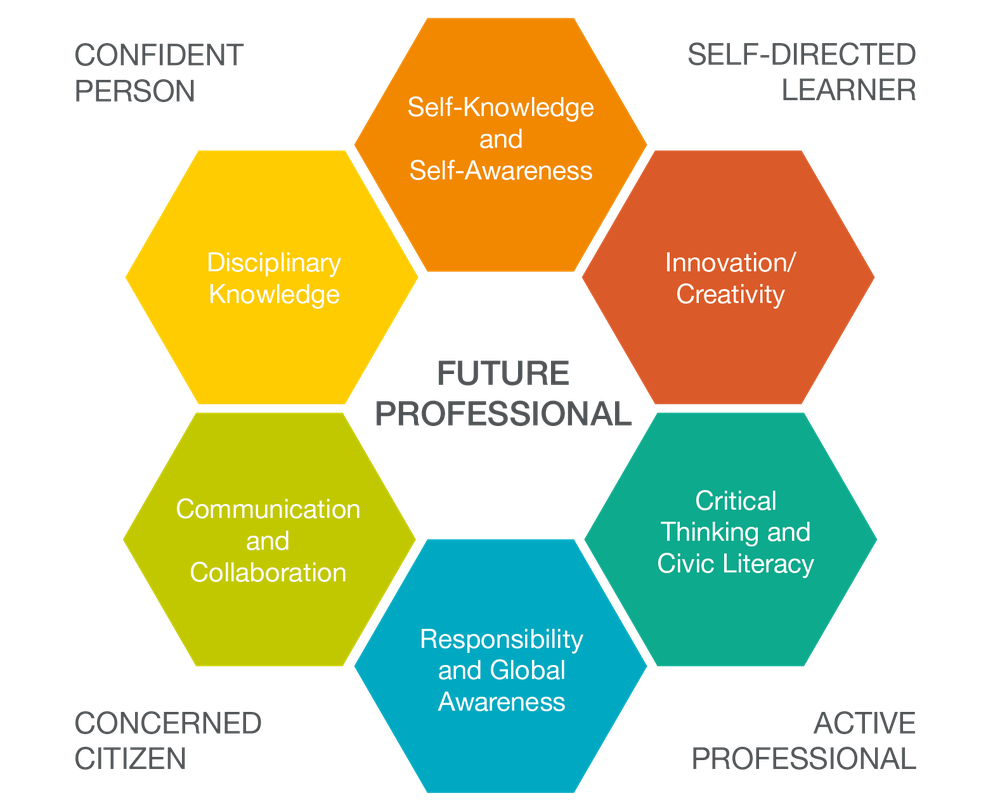
Developing Future Skills
Which competencies and skills do future university graduates need for professions that do not even exist yet? The term “future skills” refers to abilities that allow graduates of higher education to meet the challenges of the future with the best possible preparation. Within the framework of the iLab, we teach and promote these future skills in an integrative manner and with practical relevance at all three levels.
Good to Know
You can also write your bachelor or master thesis as part of the iLab. Examples?These bachelor- and master theses were created within the framework of the iLab..
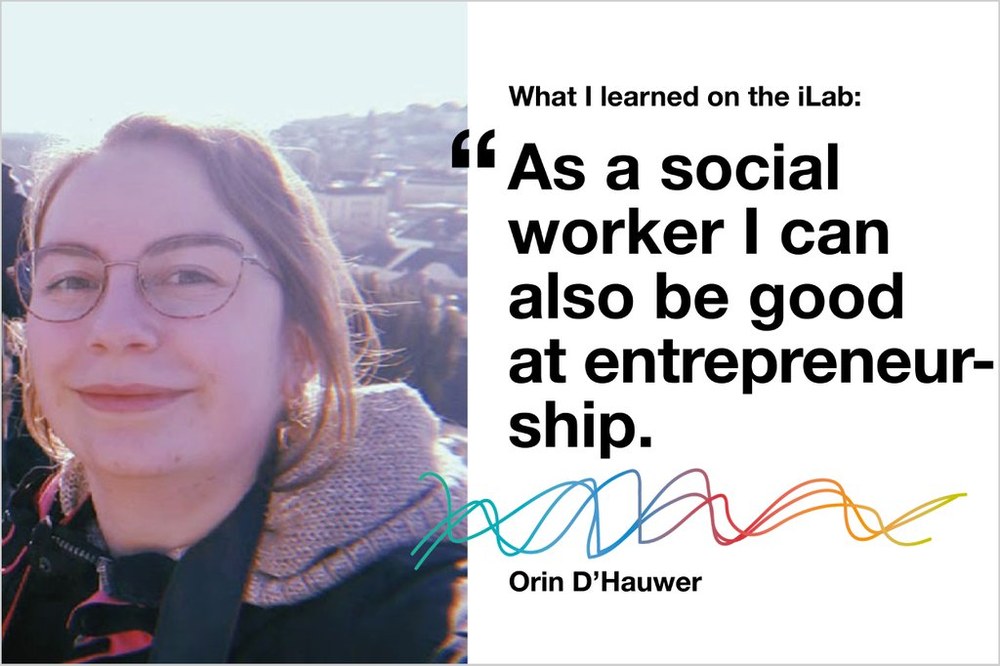
For our incoming student Orin, it was particularly important to see how a team including so many different skillsets can be coordinated and the skills put to good use.
In the podcast, the social worker from Antwerp talks about her experiences within the framework of the project work and gives insights into the “Green Den” project that she and her group developed together in line with the “United Nations’ Sustainable Development Goals”.
Sara Velasco Basurto Developed a Video Game on the Topic of Bullying
Understanding the Consequences of Bullying
“We have developed a video game that uses a playful approach to help young people understand the implications of bullying”, explains Sara Velasco Basurto. The team with their diverse professional and national backgrounds developed the video game over the project term of one semester.
“The iLab was very much like working in an international company with all the different cultural backgrounds. I learned a lot about myself and was able to improve my soft skills in addition to my specialist field”, says the product designer.
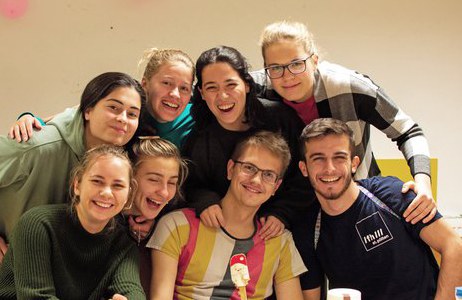
Group photo of Incoming Students | Copyright: Anet Chladkova
Martin Kazík Designed a System that Promotes Exercise and Local Businesses
Real-World Solutions for Real-World Problems
„By walking, running, or cycling in and around St. Pölten, users can collect points that they can use to get discounts in all participating shops. In this way, we create a win-win situation for individuals and small businesses that depend on walk-in customers”, explains marketing and communications expert Martin Kazík.
Students in the GreenDen developed by Orin D'hauwer and her team in the iLab | Copyright: Orin D'hauwer
Team
Doris Kantauer
Project Level
Doris Kantauer is a project manager. For the iLab she is responsible for introducing students to applied Design Thinking and to support them in the concept development phase at the project level.
“Thanks to the challenge-based learning approach, the iLab facilitates a unique learning experience that many iLab students have referred to as transformative. For me personally, it is a privilege and very fulfilling to accompany students with various backgrounds on their learning journey and the development of future skills.”
Christina Tanzer
Lab Management & Team Activities
Christina Tanzer is section head for UAS-wide offers for students and is mainly responsible for lab management and team activities within the iLab.
“The iLab opens up the students’ horizon and gives them a new perspective on their own discipline at the same time. It is a unique opportunity for them to recognise the value of their own contribution, to integrate the know-how of the individual team members, and to develop creative approaches to solutions together. From day one, teamwork in all its aspects is the key.”
Marina Tomic Hensel
Personal Level
Marina Tomic Hensel is a social pedagogue, social worker, sociologist and lecturer at the department of Social Sciences. For the iLab, she is responsible for personal development on an individual level.
“The iLab offers the opportunity to develop not only professionally and within a team, but also on a personal level. It creates a space for active participation and the opportunity to strengthen one's own skills and potential, or to discover new ones.”
Enric Torras
Team Level
Enric Torras is a social worker and FH Lecturer. For the iLab, he is responsible for Communication, Collaboration and Team Development at the team level.
"In the iLab, students can try out and develop their skills while working on real-world challenges in interdisciplinary teams. From a Social Sciences perspective, it’s fascinating to observe and support their team dynamics and development phases. As a former iLab participant myself, I know that the iLab is what you make of it – an intense and personal learning experience.”
Applying for the iLab
Applications for the iLab in the winter semester 2025/26 are closed.
The prerequisite: You must be a bachelor or master degree student of the St. Pölten UAS. In this case, you can choose the iLab instead of a regular semester from the 3rd semester onwards.
Your study programme team is happy to provide you with the details.