Digital Assistant for Inclusive Mobility
Fritz Schöggl Private Foundation Supports USTP Mobility Project

A new project of USTP – University of Applied Sciences St. Pölten explores how the use of public transport can be made more accessible for people with disabilities or physical impairments. The project proposes to develop a prototype for a digital assistant and has been granted funding worth EUR 150,000 from the St. Pölten-based Fritz Schöggl Private Foundation.
In the project with the title “EMIU Exklusiv Mobil – Inklusiv Unterwegs”, researchers are developing an aid for accessible, near real-time, and individual mobility planning and implementation in everyday life.
“Within the framework of the mobility transition, local public passenger transport has become more attractive thanks to technical innovations – but people with disabilities or physical impairments are still facing challenges and difficulties on a daily basis in this respect”, says project manager Alexandra Anderluh of USTP’s Carl Ritter von Ghega Institute for Integrated Mobility Research.
These obstacles include physical and constructional barriers such as broken or missing lifts, a lack of tactile guidance systems and less-than-accessible stations, sensory barriers like missing acoustic or exclusively visual displays, insufficient contrast, cognitive and psychological challenges in complex transport-changing situations, or stress caused by short-term changes.
Helpful Assistant in the Making
In the project, Anderluh and her colleagues are designing a prototype of an electronic assistant intended to make life easier for people with disabilities. The idea is to adapt the existing assistance system “Home Assistant” accordingly.
This well-established open-source software is to compile publicly accessible real-time data, for example for departure times, disruptions, lift malfunctions, and weather conditions and display them in a user-friendly manner. People using the assistant are to be enabled to adjust the displays to their individual needs. This includes, for instance, light and text signals for people with impaired hearing as well as voice output for visually impaired persons. Both at home and on the go, the envisioned assistant – in combination with a smartphone – is designed to help people reach their destinations safely, without stress, and without barriers.
The project team intends to test the prototype in cooperation with people with impairments. For mobility providers, the prototype can serve as the basis to expand their services accordingly.
Support for Important Research Area
This select project receives funding from the Fritz Schöggl Private Foundation. Fritz Schöggl (1931–2024) was a prominent personality for the town of St. Pölten: executive employee of the Lower Austrian health insurance provider, long-term member of the municipal council and the city senate, and key influence for the hospital and social institutions. His commitment in the sports sector was likewise strong. Schöggl was awarded many recognitions for his services including the Grand Decoration of Honour in Gold for services to the Republic of Austria and the ring of honour of St. Pölten. In 2008, he converted his fortune to a private foundation whose Executive Board now funds a research and innovation project of USTP.
“For our founder Fritz Schöggl, it was always important to stand up for people with impairments. This project literally opens door: It brings accessible travelling using public transport one step further towards becoming a reality”, explains Helmut Schebesta on behalf of the Fritz Schöggl Private Foundation.
“The project fits into the long row of research projects on inclusive mobility that have been completed by our university of applied sciences to date. Over the past years, our researchers have developed key competencies in this field which demonstrates the great benefit of our applied research on questions of and solutions to everyday challenges. I am very pleased and grateful that the Fritz Schöggl Private Foundation has decided to promote this important topic and project”, says USTP CEO Hannes Raffaseder.
The project is to run from October 2026 to December 2027.
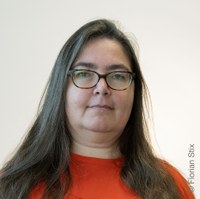
FH-Prof. Dr. Alexandra Anderluh
Senior Researcher Carl Ritter von Ghega Institute for Integrated Mobility Research Department of Rail Technology and Mobility
Mag. Gabriele Permoser
Head ofCenter for Research and Cooperation Head of Service Unit
Research and Knowledge Transfer Center for Research and Cooperation