
European Universities: The Future of Higher Education
Impulses for the Higher Education Strategy 2040
USTP_Tabea+Bender.jpg "Copyright: USTP/ Tabea Bender")
Under the title “Impulse für die Hochschulstrategie 2040: European Universities als Innovationstreiber für die Hochschulen der Zukunft!?“, the Technical University of Leoben and USTP – University of Applied Sciences St. Pölten, with their respective European Universities EURECA-PRO and E³UDRES², organised a top-class round of keynotes and discussions at the MuseumsQuartier in Vienna. More than six years after the launch of the first European Universities, the event took stock from an Austrian perspective. Representatives of European Universities with Austrian involvement presented a position paper for the Austrian Higher Education Strategy 2040. Federal Minister Eva-Maria Holzleitner took part in the event as well.
Central Impulses for the Future of Higher Education
The European Universities initiative of the European Union is among the most important developments in higher education in recent years and is increasingly shaping the strategic further development of universities in Europe. In the context of the Higher Education Strategy 2040 for Austria, which is currently in the making, the European Universities provide central impulses for the future of teaching and research, knowledge transfer and innovation for and with the business sector, societal commitment, and institutional collaboration.
More than six years after the launch of the initiative, it is evident that European Universities serve as drivers of innovation for structural transformation in higher education. At present, 73 such alliances throughout Europe are working on new forms of cooperation – from joint study programmes and micro-credentials through innovative teaching and learning scenarios to cooperative research and innovation structures as well as personnel development measures.
Austria plays an active role in this development: With EURECA-PRO (Technical University of Leoben) and E³UDRES² (USTP – University of Applied Sciences St. Pölten), two alliances are coordinated by Austrian institutions, and another 16 institutions are involved. This means that Austria is rather strongly represented in this initiative in a European comparison.
Eva-Maria Holzleitner, Federal Minister for Women, Science and Research, says: “The European Universities show that Europe is able to think big, overcome boundaries, and create new things together. This initiative is one of the most ambitious and important higher education projects of the European Union in the last several years. And in this context, Austria is not only part of the European Higher Education Area – rather, we are actively involved in shaping it and we contribute our strengths in a purposeful manner.”
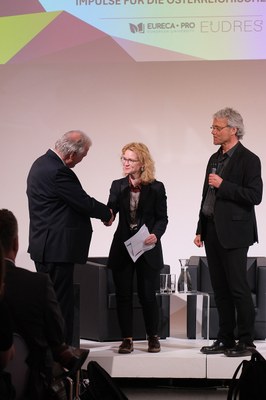 Copyright: USTP/ Tabea Bender
Further Development towards Real European Universities
The important role of European Universities is also emphasised at the political level: The government programme entails further expanding the involvement of Austrian higher education institutions and examining perspectives for a further development towards real European Universities. The objective is to strengthen the international competitiveness of this higher education location.
"European Universities create impulses for innovative teaching, accelerate the future-oriented transformation of higher education, improve the global competitiveness of the European Higher Education Area, promote diversity, resilience, and capacities for research and innovation, close skill gaps, and optimise graduates’ employability”, explains Hannes Raffaseder, USTP CEO and E³UDRES² President. “On this basis, they make a crucial and indispensable contribution to the innovative power of Europe’s future universities.”
“The European Universities initiative is our strategic driver for the universities of the future. With EURECA-PRO and partners such as E³UDRES², we put joint study programmes, micro-credentials, and cooperative innovation structures into practice. For the Higher Education Strategy 2040, we need reliable framework conditions: the recognition of joint degrees, flexible quality assurance, stable funding, and talent-oriented personnel development. Austria is already strongly positioned – now we want to take the step towards real European Universities”, emphasises Peter Moser, Rector of the Technical University of Leoben.
Position Paper on Higher Education Strategy 2040
It is against this background that representatives of the Austrian European Universities worked out a joint position paper on the Higher Education Strategy 2040. The goal is to systematically introduce the experiences gained in the Alliances into national strategy development and point out perspectives for the initiative’s further development at the same time. Numerous good practices are not only a source of inspiration for future developments at the European and global levels – rather, they offer concrete approaches to solutions to the national challenges addressed in the recently presented FORWIT analysis of the Austrian higher education system.
Broad Dialogue with European and National Stakeholders
The impulses in terms of content were deepened within the framework of a top-class round of keynotes and discussions held in the MuseumsQuartier in Vienna. The event featured representatives of the European Commission, the Federal Ministry for Women, Science and Research, and universities and student organisations throughout Austria.
Among the panellists were, e.g., Susanne Conze (European Commission, CG EAC), Elmar Pichl (BMFWF), Franziska Knogler (European Students‘ Union), Oliver Vettori (Vienna University of Economics and Business / ENGAGE.EU), Susanne Feiel (Technical University of Leoben / EURECA-PRO), Gabriele Permoser (USTP / E³UDRES²), Thomas Baumgartner (University of Innsbruck / AURORA), Julia Marinaccio (CUAS / ACE2-EU), and Elisa Kreuzeder (TU Wien / EULiST).
The welcome address was held by Federal Minister Eva-Maria Holzleitner, and the presenter was Michael Köttritsch (Die Presse).
 Copyright: USTP/ Tabea Bender
Under the motto “United Campuses of Europe!”, the event invited the participants to engage in informal exchange with the following European University Alliances with full members from Austria: ACE²-EU (CUAS – Carinthia University of Applied Sciences), ARQUS (University of Graz), AURORA (University of Innsbruck), Circle U. (University of Vienna), CIVICA (CEU – Central European University), CIVIS (University of Salzburg), EC2U (JKU Linz), ENGAGE.EU (Vienna University of Economics and Business), EPICUR (BOKU University), EU4Dual (FH JOANNEUM), EULiST (TU Wien), IN.TUNE (University of Music and Performing Arts Vienna), Neurotech.EU (Medical University of Innsbruck), RUN-EU (Vorarlberg University of Applied Sciences), ULYSSEUS (MCI – Management Center Innsbruck), Unite! (TU Graz)
