Fighting Online Hate Speech
Two USTP Research Projects Develop New Strategies against Hate Speech on the Internet
Researchers at USTP – University of Applied Sciences St. Pölten are working on making digital spaces safer. Two current projects show how technological innovation and social responsibility can go hand in hand. Whether through strengthening civic courage or through smart filter mechanisms – the research conducted at USTP pursues one goal: designing more humane, secure, and inclusive digital communication.
Hate Speech on the Internet
For quite some time now, hate speech has been more than a marginal phenomenon. Insult, discrimination, and targeted attacks are part of many people’s daily online experience – young users in particular are affected by it. While the big platforms react by deleting content and blocking users, researchers at USTP – University of Applied Sciences St. Pölten rely on innovative approaches to permanently contain hate speech and promote digital civic courage.
Two ongoing projects – “Counter Speech – Young People Against Online Hate” and “HaSPI – Hate Speech Prevention through Imitation” demonstrate how technological and social research can jointly pave the way for respectful co-existence online.
Both projects showcase how practically relevant research is conducted at USTP – as an example of digital humanism: technology for social responsibility and for the empowerment of young people.
Counter Speech: React Effectively to Hate Comments
Children and adolescents are frequently the target of hate posts, cyber mobbing, and insulting comments. The project “Counter Speech – Young People Against Online Hate“, developed at the Institute of Creative\Media/Technologies of USTP in collaboration with the Department of Sociology at the University of Vienna, wants to provide young people with tools for actively and confidently reacting to hate speech.
“Instead of deleting or blocking problematic content, the project relies on ‘citizen-generated counter speech’ – that is, counter speech from the community. Counter speech is identified and made visible using automated data analysis and AI methods”, emphases Djordje Slijepčević, Deputy Head of Research Group at the Institute of Creative\Media/Technologies of USTP.
In this way, young people learn how to effectively react to hateful comments without finding themselves on the defensive.
CounterHelp App for TikTok
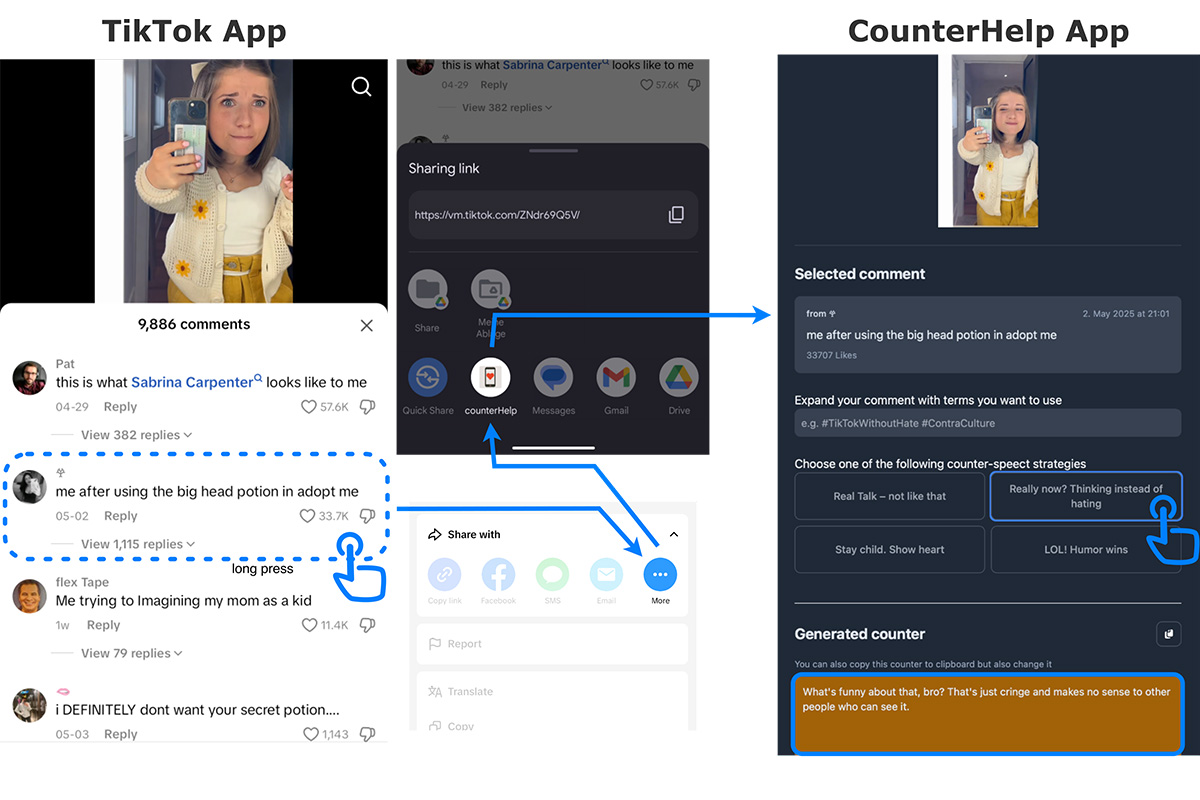
A central outcome of the Counter Speech project is the development of the app “CounterHelp” which helps young people to easily create their own counter speech comments on TikTok. The app analyses the selected comment, takes all connected information into account, and uses a language model to generate suggestions in different styles – from empathic to humorous. A user study confirms the tool’s usefulness and broad acceptance.
Award-Winning Innovation: CounterHelp Wins Prize at International Conference
The scientific implementation of this approach was presented under the title “Promoting Online Civil Courage Among Young People Through AI-Generated Counterspeech”. The research team won the Best Interactive Experience Demo Award at the specialist symposium ACM Multimedia – the leading international conference in the field of multimedia research. The recognition is used to honour the technological quality and social impact of the developed solution.
“CounterHelp demonstrates how generative AI and modern language models can be meaningfully used to support young users of online platforms. We hope that CounterHelp will inspire the development of counter speech assistants for social media platforms”, says Matthias Zeppelzauer, Head of the Research Group Media Computing at USTP.
Transparent AI Method to Recognise Hate Speech and Counter Speech
In addition, the Counter-Speech team has also developed a new method for detecting and classifying hate speech and counter speech. This sets new standards in terms of transparency and efficiency. In the latest publication, “Distilling Knowledge from Large Language Models: A Concept Bottleneck Model for Hate and Counter Speech Recognition”, a novel approach to speech analysis is presented that goes beyond conventional text-based methods. The new method is based on abstract, human-understandable concepts such as “sexist”, “provocative”, and “loving”, which were developed in collaboration with sociologists from the University of Vienna. These concepts capture the intent and tone of messages and social media posts. Based on these concepts, compact and transparent AI models can be created that detect hate speech and counter speech accurately, interpretably, and resource-efficiently.
Counter Speech marks an important advancement in the struggle against online hate speech and offers a powerful tool for the recognition of hate speech and the promotion of constructive counter speech.
HaSPI: Automated Recognition of Hate Speech
While “Counter Speech” focuses on empowering users, the new research project “HaSPI – Hate Speech Prevention through Imitation” follows a different approach: It develops a technical solution for the automated recognition and moderation of hate speech in the German-speaking area.
Under the lead of Senior Researcher Sebastian Neumaier (from the Institute of IT Security Research at USTP), the researchers use methods of Imitation Learning – that is, machine learning through imitating human decisions. The software learns based on a comprehensive dataset provided by derStandard.at.
“In the project HaSPI, we focus on an innovative machine learning approach for detecting hate speech: By way of imitation, the models are supposed to gain a better understanding of online hate speech in various context – and thus learn to classify it better. The project relies on the One-Million-Posts dataset corpus of STANDARD which includes numerous decisions taken by experienced moderators and constitutes an ideal basis for training the models”, explains Tobias Kietreiber, deputy project manager and Junior Researcher at the Institute of IT Security Research.
Smart Moderation
The researchers behind HaSPI strive to develop an intelligent moderation system that reliably assesses German-speaking contexts in particular. The project thus addresses a key challenge: Many existing AI systems for hate speech recognition are optimised for English and are inadequate when it comes to other languages.
 Anna Neubacher
About Counter Speech
The research project was implemented in collaboration with the University of Vienna and the Austrian Institute for Applied Telecommunications (OIAT). Counter Speech was supported by the Vienna Science and Technology Fund (WWTF). Univ.-Prof. Ulrike Zartler-Griessl from the Department of Sociology at the University of Vienna had the project lead.
- More information on the project is available on the USTP research website.
- Paper: CounterHelp App: „Promoting Online Civil Courage Among Young People Through AI-Generated Counterspeech“
- Paper: “Distilling knowledge from large language models: A concept bottleneck model for hate and counter speech recognition”
- CounterHelp-Video
About HaSPI
This project is supported by ‘netidee’, Austria’s large-scale open source internet promotion campaign which is organised and financed by the ‘Internet Stiftung’ in line with its non-profit foundation purpose: promoting the internet in Austria. In the long term, HaSPI is to be freely available for the operators of forums, blogs, or online platforms as an effective and transparent moderation aid.
- More information on the project is available on the USTP research website.
- netidee blog post: “Hate doesn’t only speak English”
- “One Million Posts“ corpus: approx.11,000 datasets from comments and posts at ‘der standard.at’
Universities of Applied Sciences Demand Right to Award Doctorates
The Austrian University of Applied Sciences Conference (FHK) demands that the Austrian universities of applied sciences (UAS sector) be granted the right to award doctorates. USTP – University of Applied Sciences St. Pölten supports this demand. The research field of media and digital technologies is very well established at USTP and has been expanded considerably over the past years. It is important for USTP to be given the opportunity to offer its own PhD programmes. Universities of applied sciences maintain close networks with companies and regional structures. Doctoral students drive forward key technologies and innovations that are then incorporated into the economy, industry, and SMEs. Regions benefit from these people’s stronger ties to the location, while businesses profit from practice-oriented research.

FH-Prof. Priv.-Doz. Dipl.-Ing. Mag. Dr. Matthias Zeppelzauer
Head ofMedia Computing Research Group
Institute of Creative\Media/Technologies Department of Media and Digital Technologies

Dipl.-Ing. Dr. Djordje Slijepčević , BSc
Deputy Head ofMedia Computing Research Group
Institute of Creative\Media/Technologies Senior Researcher Institute of Creative\Media/Technologies Department of Media and Digital Technologies