Forward-looking European Campus Hainburg
The Province of Lower Austria is investing in a unique partnership between leading European higher education institutions, with USTP as a partner.
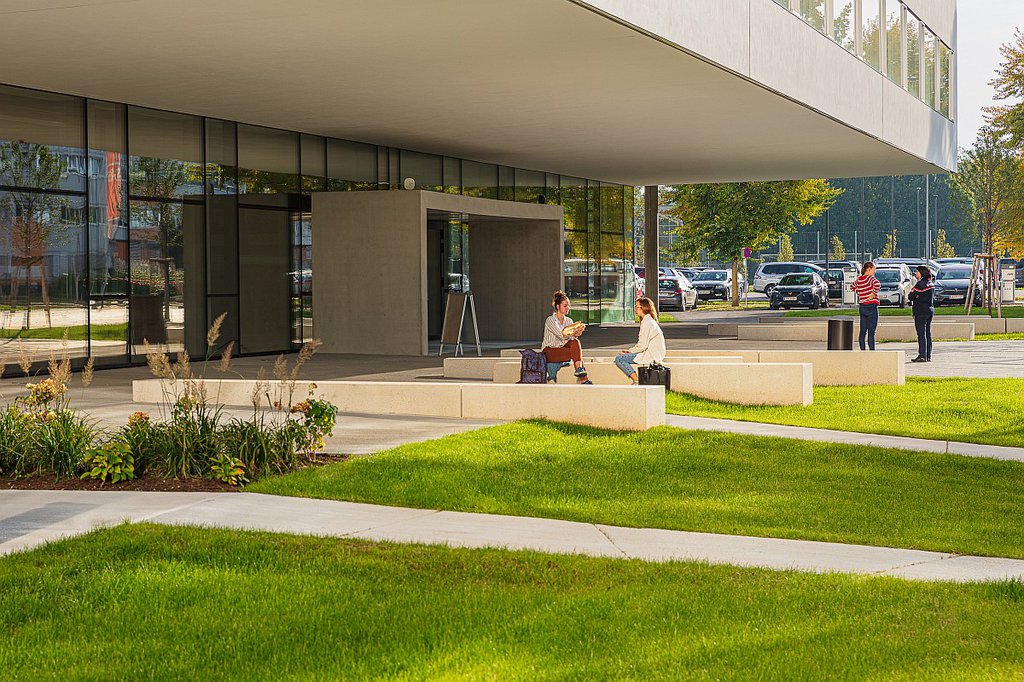
The Province of Lower Austria is taking an important step to further strengthen Lower Austria as a center for education and research: Based on a new governmental resolution, Campus Hainburg will undergo a comprehensive conceptual and structural realignment and will in future operate under the name “European Campus Hainburg.”
The new concept provides for research and education in key future-oriented fields such as green technologies, smart and sustainable innovation, and entrepreneurship.
Governor Johanna Mikl-Leitner emphasized:
“The European Campus Hainburg represents another key component of our ‘Mission Nobel Prize,’ through which we aim to offer the best minds the best possible conditions in Lower Austria. With the European Campus Hainburg, we are creating a unique place of collaboration among leading European higher education institutions, where science, research, and industry work hand in hand to develop solutions to the challenges of the future.”
Deputy Governor and Provincial Councillor for Science Stephan Pernkopf also highlighted the importance of the project:
“With the European Campus Hainburg, we are focusing on high technology, regional strength, and science. In doing so, we are creating solutions for the future of our province and far beyond. The cooperation of universities of applied sciences and universities at a shared location enables flexible research structures, from which we also expect tangible results, for example for the economy.”
Leading Role of USTP
USTP – University of Applied Sciences St. Pölten, formerly St. Pölten University of Applied Sciences, will assume a leading role at the European Campus Hainburg. In line with the new thematic focus, USTP will develop academic programs and offer them starting in the winter semester 2028/29. At full capacity, nearly 500 students are expected to complete their degree programs or continuing education offerings at the campus.
“The European Campus Hainburg represents a unique opportunity to implement exemplary approaches to future-oriented teaching, research, and innovation. We will build on our extensive experience gained through coordinating the European University E³UDRES² and, in close cooperation with partners from academia, industry, and society, provide strong momentum for the cross-border region. These initiatives are intended to gain recognition as best practice and to attract motivated talent to the region,” stated USTP Managing Directors Hannes Raffaseder and Johann Haag.
Future participation by IMC University of Applied Sciences Krems and Wiener Neustadt University of Applied Sciences is also envisaged. An intensive cooperation with TU Wien (Vienna University of Technology) was already announced last summer.
Cooperation within European University Alliances
Through the involvement of TU Wien and USTP, cooperation within two European university alliances will also be implemented: EULiST, coordinated by TU Wien, and E³UDRES², led by USTP.
E³UDRES² is an alliance of nine universities and universities of applied sciences from across Europe, including institutions in Finland, Portugal, and Germany. Its objective is to promote the development of small and medium-sized cities and their rural surroundings into intelligent and sustainable European regions. Overall, E³UDRES² represents approximately 10,000 staff members and 100,000 students.
EULiST, comprising ten universities across Europe, aims to strengthen trust in science, advance the green and digital transformation, and foster social cohesion. In this context, TU Wien, together with the Slovak University of Technology in Bratislava (STU), plans to establish several research groups at the European Campus Hainburg, focusing on areas such as green chemistry, hydrogen technologies, sustainable mobility, and artificial intelligence in environmental engineering. Cooperation with industry partners is also planned, including companies such as Agrana, OMV, and Krems Chemie, all of which are already involved through the INTERREG program.
A Concept Unique in Austria
By bringing together universities of applied sciences and universities at a single location, an Austria-wide unique model is being created. In the future, students will be able to pursue new and flexible educational pathways.
In conclusion, Mikl-Leitner and Pernkopf emphasized:
“The European Campus Hainburg will become a symbol of a new interaction between science, industry, and society—and a European hub for the future with impact far beyond the borders of Lower Austria.”
Further details can be found in the press release of the province of Lower Austria.