
Franz Bogner Academic Award for Bachelor's Thesis on the Wind Power Debate
Why do climate change campaigns so often fall flat?
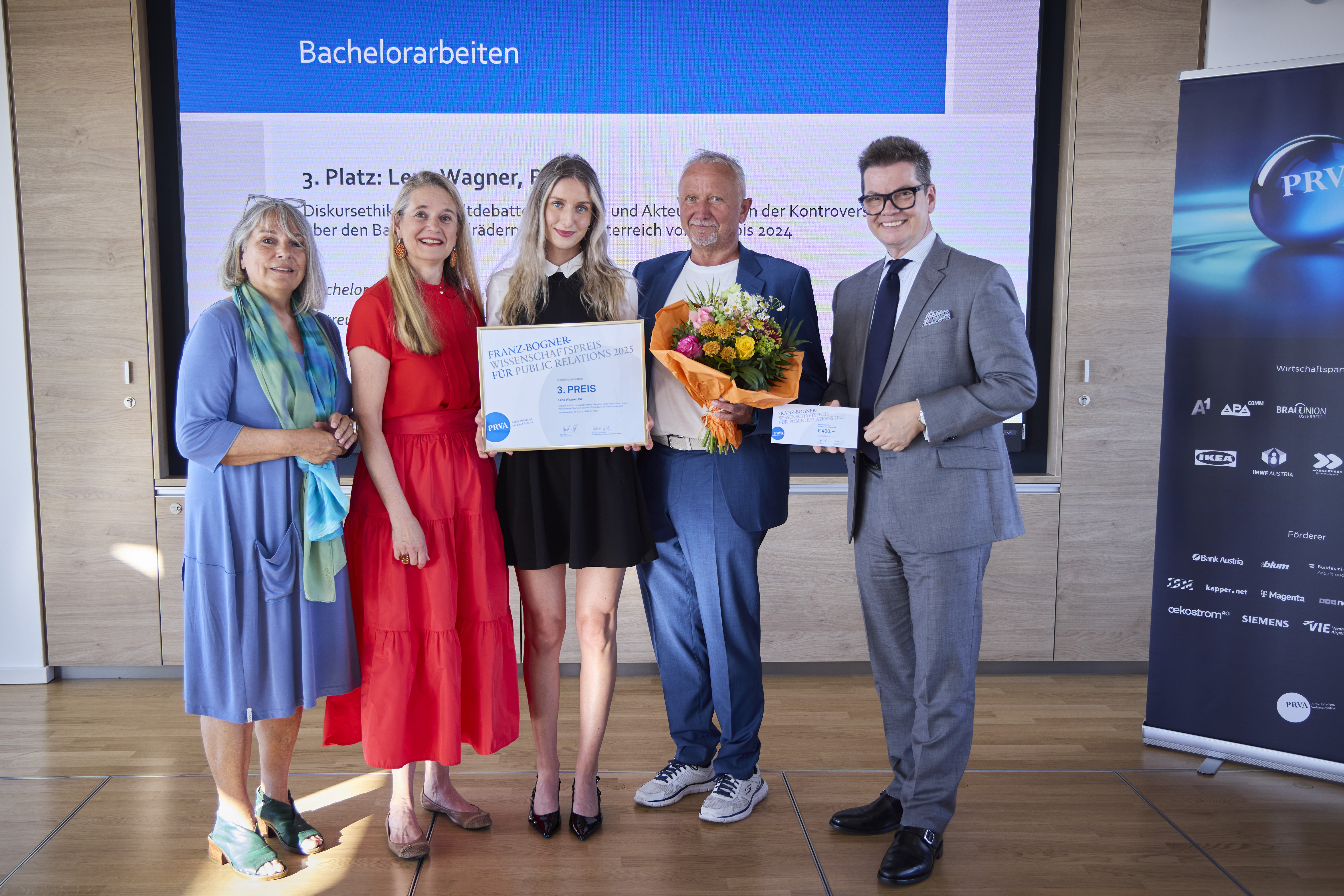
On May 28, 2026, Lena Wagner received one of this year's Franz Bogner Science Awards for PR in Vienna. The award recognized her bachelor's thesis in the Media Management program at USTP – University of Applied Sciences St. Pölten, which analyzes the controversies surrounding the construction of wind turbines in Lower Austria. This is already the second prize for the study: in 2025, Lena Wagner received a Different Brilliant Award for it. The thesis was supervised by Simon Ganahl, who works as a Researcher in the Media Business group at the Institute of Creative Media Technologies (ICMT).
Who is heard in environmental debates?
At the heart of the study lies a simple yet essential question: Who is actually heard in environmental debates—and who is not? The case study focuses on the planned construction of several wind turbines in the Waldviertel region of Lower Austria since 2013, a project that sparked a broad public debate. Lena Wagner analyzed the content of various media reports in this controversy, drawing theoretically on Jürgen Habermas' discourse ethics, Konrad Ott's environmental ethics, and Hans Jonas' principle of responsibility.
The results are striking: human interests were mentioned nearly three times as often as the concerns of those actors who cannot speak for themselves—animals, plants, ecosystems, and future generations. The forms of communication also differed greatly. While institutionally anchored proponents relied on factual formats such as press releases and studies, opponents—mostly organized in citizens' initiatives—resorted to more emotional genres such as memes, music, and videos. A structural power imbalance became apparent.
From Research to Teaching
The study was conducted in the context of the research project Climate Media Frames (CliMeF) at the Institute of Creative Media Technologies (ICMT) and exemplifies how research and teaching intertwine at USTP.
"Lena Wagner's bachelor's thesis is an excellent example of the integration of research and teaching that we foster in the Department of Media and Digital Technologies and particularly in the Media Management program," states Simon Ganahl and adds: "Her study confirms our findings that—as a society in general and especially in Lower Austria—we must find new participatory and not merely human-centered approaches to environmental and climate communication."
Standards for Fair Environmental Communication
Based on the results, the thesis derives concrete approaches for making media communication in environmental debates more equitable: early participation, the promotion of inclusive dialogue formats, institutional empowerment of marginalized voices, and greater media visibility for ethical issues. In doing so, it provides not only an analysis of the wind power debate but also benchmarks for future environmental communication—a topic that remains highly relevant in Lower Austria.
Further Links:
Mag. Dr. Dr. phil. Simon Ganahl
ResearcherMedia Business Research Group
Institute of Creative\Media/Technologies Department of Media and Digital Technologies
