Great success at the ESMAC Conference 2026
Year’s annual meeting of the European Society for Movement Analysis in Adults and Children
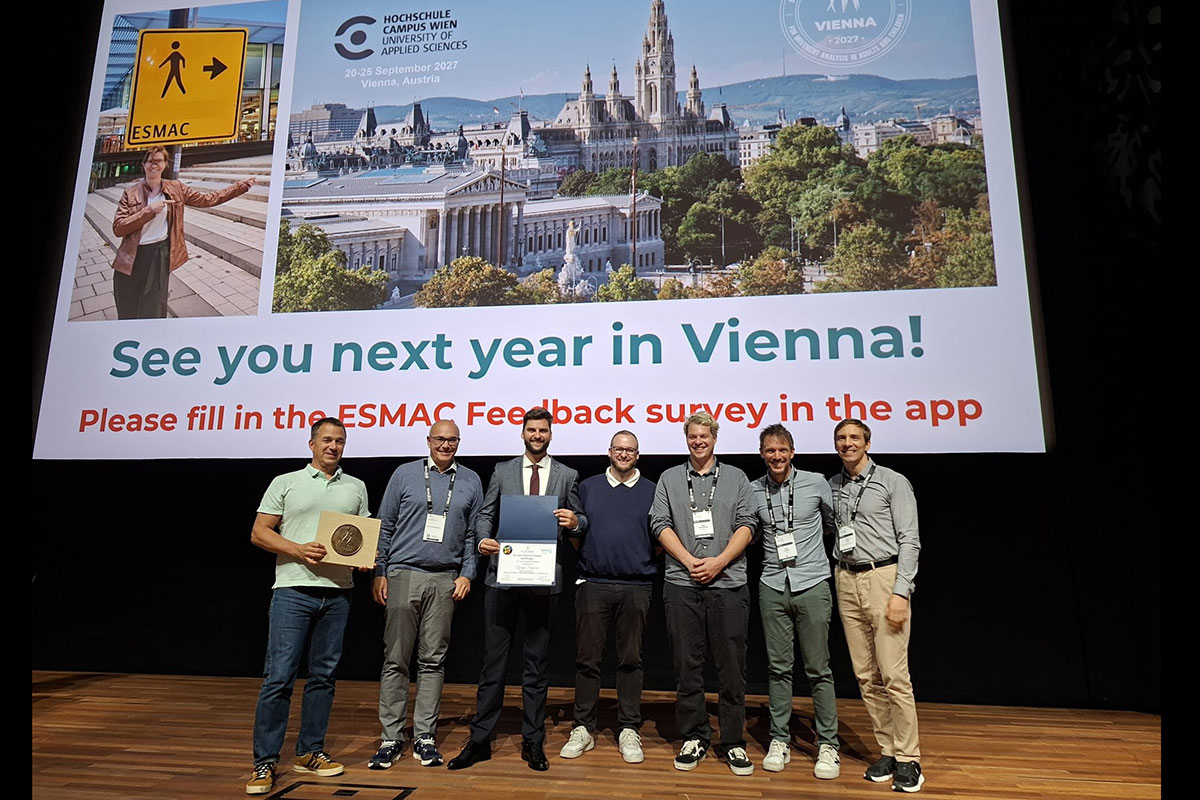
At this year’s annual meeting of the European Society for Movement Analysis in Adults and Children (ESMAC), USTP – University of Applied Sciences St. Pölten was once again strongly represented. ESMAC is one of Europe’s leading conferences in the field of clinical gait and movement analysis and took place in Maastricht and Hasselt in 2026 under the theme “Crossing Borders.”
The USTP team, represented by Djordje Slijepcevic, Mark Simonlehner, Philipp Wegscheider and Brian Horsak, contributed a total of eight scientific presentations and celebrated several notable achievements:
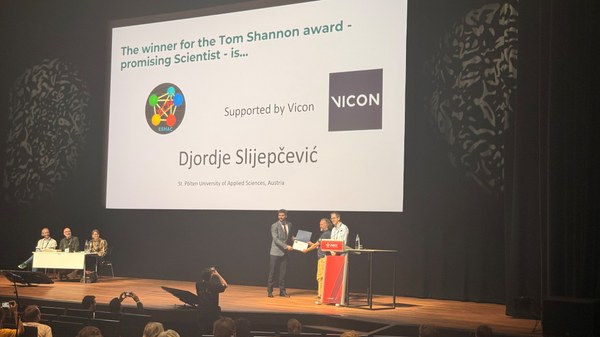
Djordje Slijepcevic from the Institute of Creative\Media/Technologies (IC\MT) received the ESMAC Early Career Award (Dr. Tom Shannon Award). The award is presented annually by the ESMAC Early Career Network to early-career researchers and clinicians working in the field of movement analysis.
Copyright: Brian Horsak
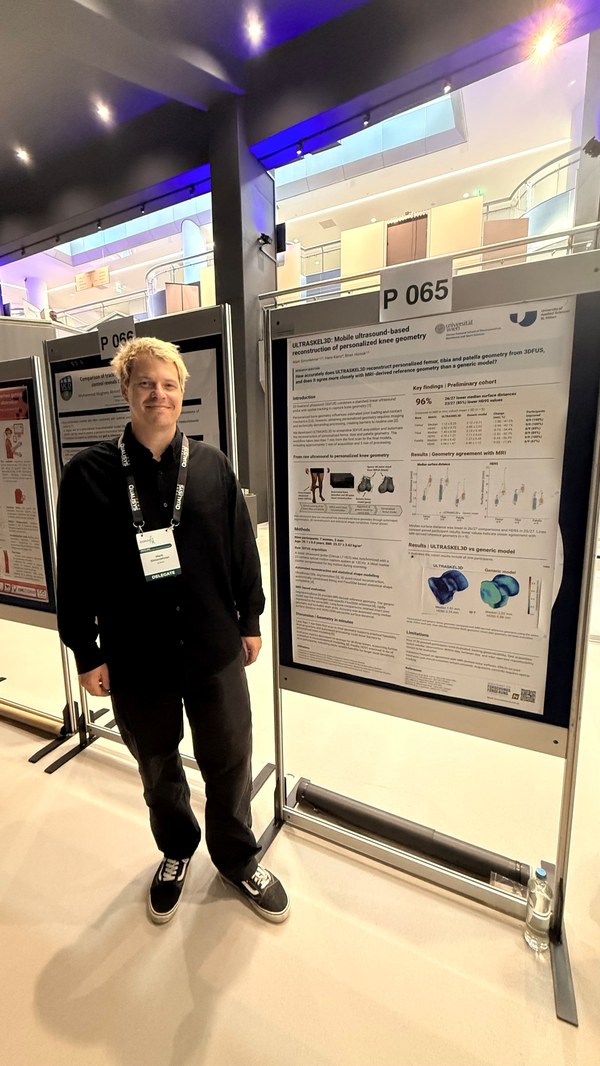
Mark Simonlehner from the Institute of Health Sciences and the Center for Digital health and Social Innovation won 1st place in the Best Poster Award for his work “ULTRASKEL3D: A 3D freehand ultrasound workflow for subject-specific knee-geometry modelling.” The study forms part of his ongoing PhD project and presents a novel workflow for generating subject-specific 3D knee geometry models using freehand ultrasound.
Copyright: Brian Horsak
In addition, USTP researchers presented eight further contributions covering current research in gait and movement analysis.
Horsak, B., Quehenberger, V., Dumphart, B., Slijepčević, D., Wegscheider, P., Kainz, H., Tanja, K., Svehlik, M., Krebs, A., Kranzl, A., 2026a. Concurrent validity of OpenCap-derived joint kinematics in children with cerebral palsy: Do alternative pose estimators improve accuracy?, in: Gait & Posture, SI: ESMAC 2026 Abstract. p. 110389. https://doi.org/10.1016/j.gaitpost.2026.110389
Horsak, B., Quehenberger, V., Simonlehner, M., Kranzl, A., Dumphart, B., Wegscheider, P., Krebs, A., Slijepčević, D., 2026b. Mesh2Sim: Benchmarking a novel monocular mesh-based markerless motion capture approach against OpenCap and OpenCap-Monocular in children with cerebral palsy, in: Gait & Posture, SI: ESMAC 2026 Abstract. p. 110390. https://doi.org/10.1016/j.gaitpost.2026.110390
Kranzl, A., Horsak, B., Töller, D., Slijepcevic, D., Krondorfer, P., Kainz, H., Unglaube, F., 2026. Different musculoskeletal models, same clinical conclusion? A comparison of medio-lateral knee joint loading estimates, in: Gait & Posture, SI: ESMAC 2026 Abstract. p. 110435. https://doi.org/10.1016/j.gaitpost.2026.110435
Russo, Y., Hirschbichler, S., Wegscheider, P., Schweiger, H., Kisiel, M., Simonlehner, M., Horsak, B., Siragy, T., 2026. Asymmetric motor impairment is associated with greater gait variability in the most affected leg in people with Parkinson’s disease, in: Gait & Posture, SI: ESMAC 2026 Abstract. p. 110504. https://doi.org/10.1016/j.gaitpost.2026.110504
Simonlehner, M., Kainz, H., Horsak, B., 2026. ULTRASKEL3D: A 3D freehand ultrasound workflow for subject-specific knee-geometry modelling, in: Gait & Posture, SI: ESMAC 2026 Abstract. p. 110526. https://doi.org/10.1016/j.gaitpost.2026.110526
Siragy, T., Russo, Y., Hirschbichler, S., Wegscheider, P., Schweiger, H., Kisiel, M., Simonlehner, M., Nantel, J., Horsak, B., 2026. Validating an open-source virtual reality platform (VReeze) for examining freezing of gait in people with Parkinson’s Disease – preliminary results, in: Gait & Posture, SI: ESMAC 2026 Abstract. p. 110527. https://doi.org/10.1016/j.gaitpost.2026.110527
Slijepcevic, D., Astl, M., Koller, W., Zeppelzauer, M., Horsak, B., Schwartz, M.H., Kainz, H., 2026. Machine learning-based prediction of knee joint contact forces in cerebral palsy using a physics-informed loss function, in: Gait & Posture, SI: ESMAC 2026 Abstract. p. 110528. https://doi.org/10.1016/j.gaitpost.2026.110528
Wegscheider, P., Schweiger, H., Russo, Y., Simonlehner, M., Kisiel, M., Hirschbichler, S., Horsak, B., Siragy, T., 2026. The effect of walking with a virtual reality head-mounted-display on dynamic stability in people with Parkinson’s Disease, in: Gait & Posture, SI: ESMAC 2026 Abstract. p. 110571. https://doi.org/10.1016/j.gaitpost.2026.110571
Ahead of the main conference, Brian Horsak and Djordje Slijepcevic jointly delivered a pre-conference seminar for the second time. Under the title “Machine Learning for Clinical Gait Analysis: A Quick Start Guide for Newcomers,” they provided participants with a practical introduction to machine learning and demonstrated how data-driven methods can be applied in clinical gait analysis. Brian Horsak also had the honor of chairing a session on markerless motion capture in clinical gait analysis.
USTP’s successful participation in ESMAC 2026 highlights its strong international presence in digital and instrumented movement analysis and provided an excellent opportunity for scientific exchange with leading experts from research and clinical practice.