Ideas for the Workplace of Tomorrow
At the E³UDRES² Hackathon, students from three countries developed innovative solutions on AI, regional identity, and the future of work
EUDRES_USTP.jpg "Copyright: EUDRES/USTP")
In early December, the annual E³UDRES² Hackathon took place at USTP – University of Applied Sciences St. Pölten. Under the motto “Connecting Europe by Shaping Regional Identities in our Workplace”, around 40 students from Austria, Hungary, and Romania worked together on innovative ideas for the workplace of the future.
AI, Regional Identity & The Future of Work
This year’s challenges were provided by Cloudflight, a European software company with a location in St. Pölten, and by the Vienna State Opera. Cloudflight invited teams to explore the role of artificial intelligence and regional identity in future working environments. The Vienna State Opera posed the question of how AI agents can be used to personalize and enhance the customer journey.
The hackathon was held simultaneously at three European locations – each with its own thematic focus. In addition to St. Pölten, further “hubs” took place at Fulda University of Applied Sciences (Germany) and Jamk University of Applied Sciences (Finland).
Days Full of Creativity, Team Spirit and Innovation
At USTP, participants experienced a diverse and engaging program that turned the event into far more than a traditional ideation format. The agenda included teambuilding sessions, expert inputs on topics such as UI/UX design, AI ethics and storytelling, as well as a final award ceremony.
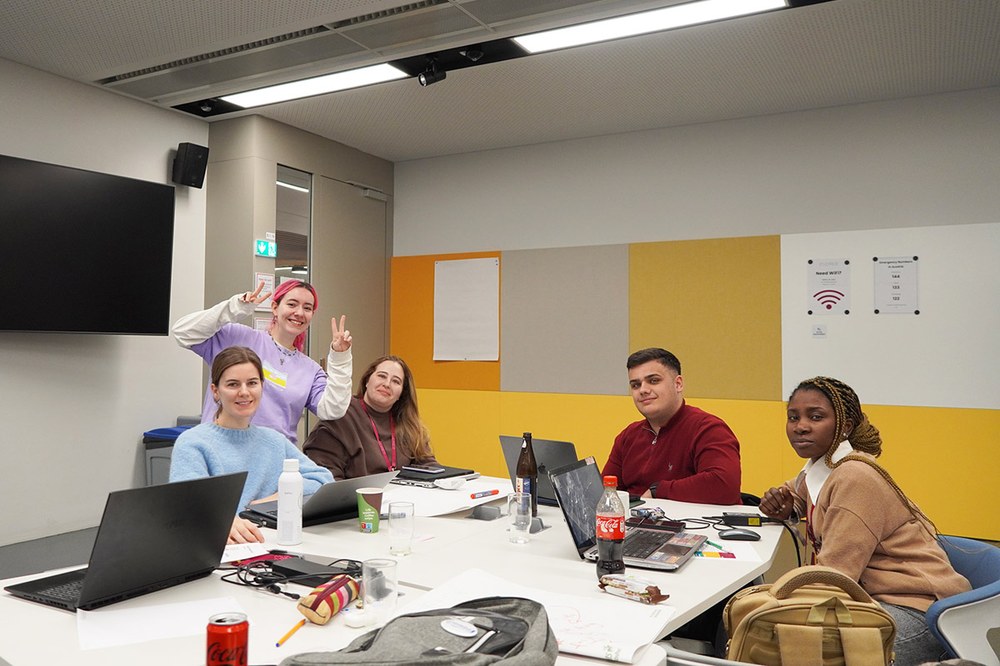
Copyright: EUDRES/USTP
For students who wanted to continue working overnight on campus, USTP provided a dedicated chill-out area with free snacks and drinks. A food truck added to the atmosphere, offering meals and a relaxed evening environment.
Celebratory Award Ceremony
At the end of the hackathon, the student teams proudly presented their developed solutions to a six-member expert jury. “On the one hand, the target group–specific results are impressive, but even more remarkable is the process itself: in this learning format, students combine their diverse expertise, demonstrate team spirit and innovative strength, and show incredible perseverance during the 24-hour working phase,” summarized Christina Tanzer, overall organizer of the hackathon. Together with the E³UDRES² organizing team — Ramona Mauthner and Dorottya Rececki — as well as Mariia Serafimova from LEARN, students rounded off the successful hackathon during the award ceremony.