Review: Symposium on Media Ethics 2026
Focus on Robotic Systems, AI, and Robot Journalism
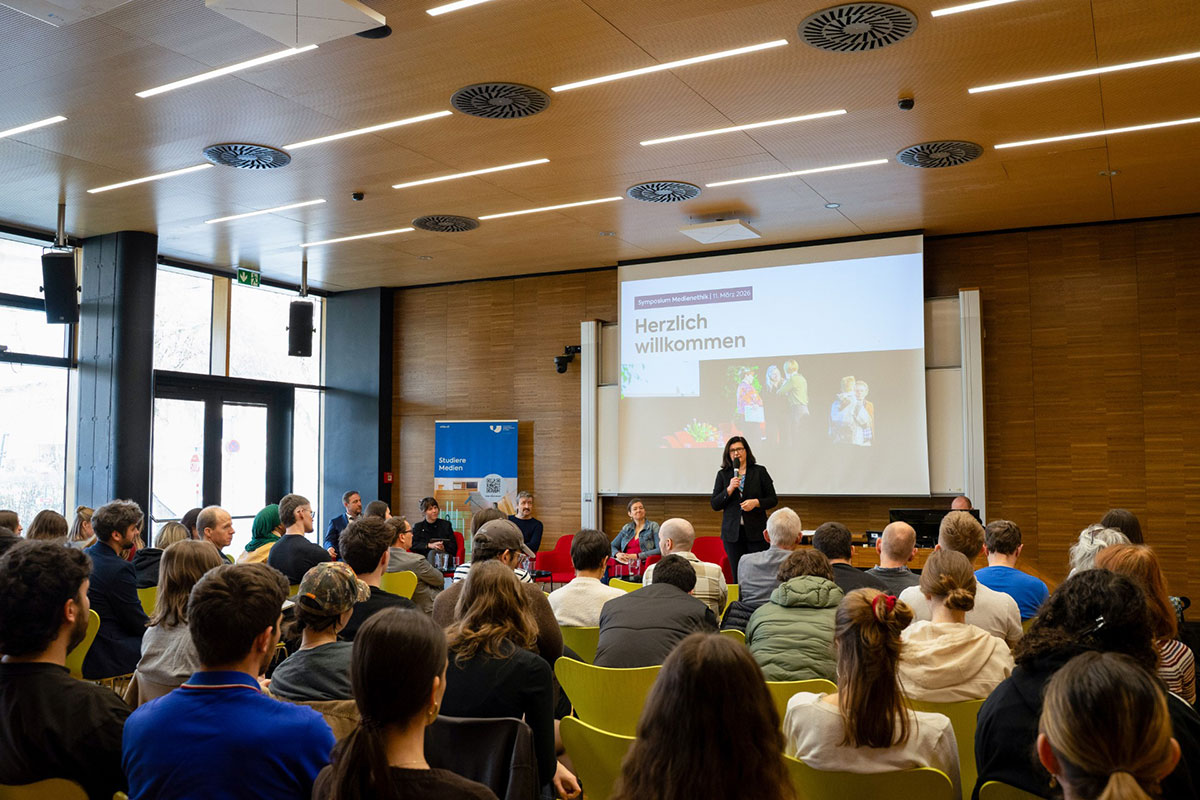
Copyright: Florian-Emeka Ezeabasiri
In 2026, the annual practice-oriented research and teaching symposium on “Media Ethics” of USTP – University of Applied Sciences St. Pölten focused on robotics, humanoid robots, and robot journalism and explored how the media report on this socially controversial topic. The event was dedicated to current trends, opportunities, and risks for society associated with robotic systems, artificial intelligence, and humanoid robots – and to how these are reflected in the media and in journalism.
Rapid Development and Fundamental Questions
“The fast-paced development of these systems, which more and more rely on artificial intelligence and tend to take humanoid form, increasingly shapes our society and meets with growing interest among commercial enterprises that consider them to be new chances for value creation. You can see these tendencies in nursing, mobility, industry, sometimes even in the cultural field. New forms of AI-assisted robotics come with fundamental questions”, says Michael Litschka, Head of USTP’s Media Business Research Group and the symposium’s organiser.
Among other topics, the event explored how autonomous and humanoid robotics change both societal cooperation and the labour market, which ethical challenges arise from AI-supported robotic models, which security aspects need to be considered, which regulations are needed, how the use of these systems influences human creativity, for example in content production, and which responsibilities the media have when it comes to the application and dissemination of technologies.
Consent, Caring Robots, Decision-Making Capability
A group of experts from the realms of science, media practice, and technology held short presentations and discussed the topics both on the podium and with the audience.
Ulrike Bechtold from the Institute for Technology Assessment (ITA) of the Austrian Academy of Sciences (ÖAW) held a keynote on our bond with anthropomorphic machines and on accompanying questions of media ethics.
“The role of the media is decisive when it comes to robotics because they significantly shape the public discourse. However, this is not – or not yet – a matter of detailed questions concerning robots and the acceptance of certain applications or features. It is about social acceptance in general: What do we, as a society, mean by ‘good life’, and which role should or can robotics play in this regard? Rather than forcing technology into as many spheres of life as possible, it is the circumstances of life that ought to define the technology”, explains Bechtold. According to her, this takes a broad discourse that integrates diverse groups and puts the people first instead of focusing on what is technically possible. “The important question is: Who do we ask? Who gets to decide or consent to where the technology is used?”, she adds.
Christopher Frauenberger from it:u (interdisciplinary transformation university austria) provided an input on “Caring Robots”. He pointed out that robotics and AI increasingly permeate diverse spheres of life, even those that are deemed inherently human activities – such as nursing. “These technical systems are very often designed in such a way that they invite the attribution of human traits, e.g., through large eyes, human-like movement, natural language use, etc. This raises fundamental questions about the type of relationship that we develop with these systems. Can we trust them? Will they care for us? Do they assume responsibility? Which experiences remain authentic? Does it make a difference? And do we want this? We dedicate ourselves to these questions in the field of tension between nursing and robotics and we conduct research on possible design strategies for desired futures with technologies that are increasingly independent in their actions”, states Frauenberger.
Christian Jandl, Head of USTP’s Digital Technologies Research Group, presented recent development in industrial robotics. “Robotics is currently undergoing a fundamental paradigm shift: We are seeing an evolution from rigidly programmed machines towards systems that perceive their environment, understand context, and are able to plan their actions autonomously. Vision-language-action models combine language, images, and actions and allow robots to perceive the world around them for the first time. Robots thus approach something like human decision-making”, explains Jandl.
Trustworthy AI and the Role of the Media
Verena Krawarik from the APA Media Lab presented the project “Austrian Lab for AI Trust”. “This project allows for a reflected approach to AI through the provision of risk dossiers for selected areas of application. One example is the dossier on the use of AI in imaging diagnostics, another is the AI-based recognition of hate speech. The target group includes stakeholders in medicine, administration, and the media. Only those who are familiar with the technologies’ pros and cons can consider using them professionally.”
Leonie Möck from the Department of Philosophy at the University of Vienna gave a lecture on responsibility in the discourse on robotics: “The media are prominently involved in shaping the discourse on robotics and AI. They influence how responsibility for technological developments is perceived and negotiated. Narratives of neutrality, inevitability, and the loss of control can stall the discourse on responsibility. This is why countering such narratives is an important task for the media. Moreover, I advocate a relational understanding of responsibility that puts the focus on concrete relationships as the starting point for the discussion of responsibility.”
The event is a collaboration of USTP’s Department of Media & Digital Technologies and the IMEC (Interdisciplinary Media Ethics Centre).
Symposium on Media Ethics 2026
“Robotik, humanoide Roboter, Roboterjournalismus: Was und wie berichten Medien über ein gesellschaftlich brisantes Thema?“
(“Robotics, humanoid robots, robot journalism: What and how do the media report on a socially controversial topic?”)

FH-Prof. Priv.-Doz. Dr. Michael Litschka
Head ofMedia Business Research Group
Institute of Creative\Media/Technologies Senior Researcher
Media Business Research Group
Institute of Creative\Media/Technologies Department of Media and Digital Technologies