
Round Table – Future Early Childhood Education
USTP hosted an event at the USTP CityLounge on 24 June 2026
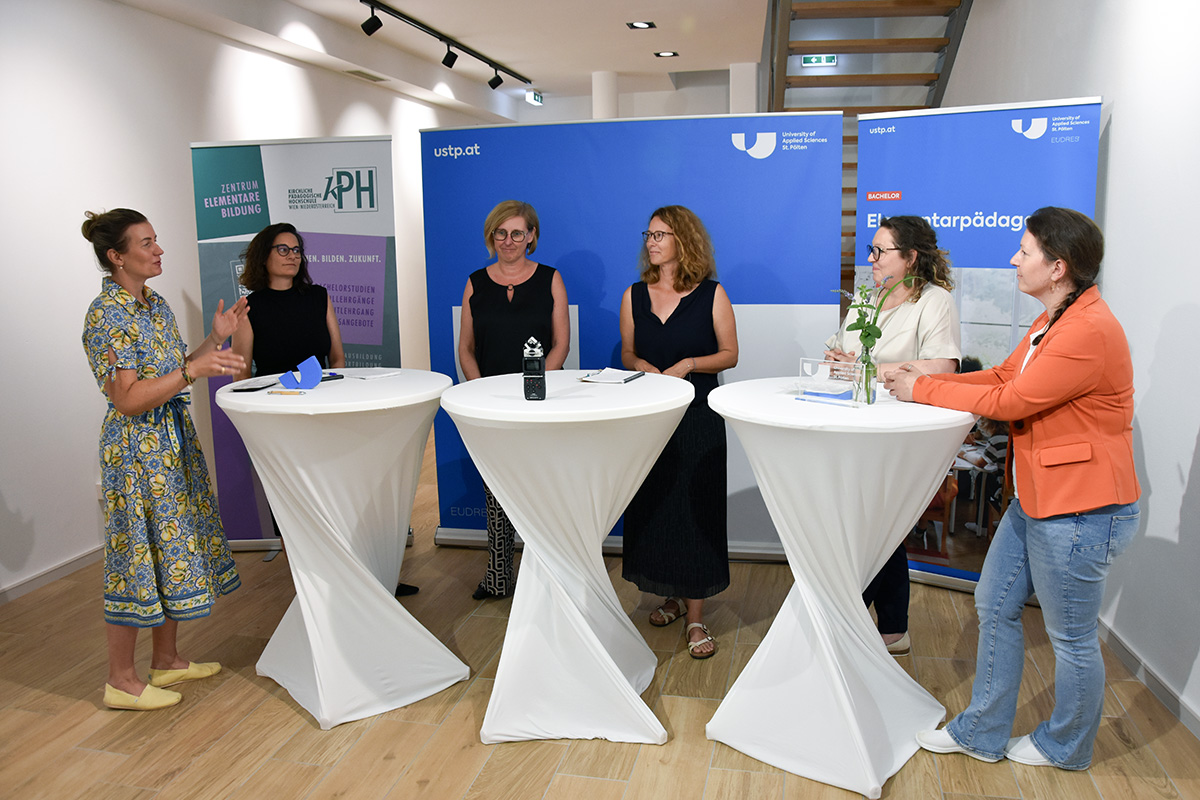
The Round Table on Early Childhood Education was all about current developments, future challenges and diverse perspectives. It was hosted by USTP – University of Applied Sciences St. Pölten. From autumn, the university will launch its new bachelor programme Early Childhood Education1. The event put a spotlight on training future professionals while enabling them to combine working and studying. USTP signed a new cooperation agreement between KPH Vienna/Lower Austria to lay the groundwork to foster cooperation between institutions, which was highlighted as a cornerstone of the programme.
What children experience and learn during their first years of life has a profound impact on their future educational journey. The importance of early childhood education therefore extends far beyond early childhood itself. At the same time, parents, children, educators and policymakers are facing growing challenges in the field of early childhood education due to skills shortages, societal change and evolving requirements. With its new bachelor degree programme in Early Childhood Education1, USTP marks a milestone for the training of future professionals. The developments currently shaping the field of early childhood education and the measures needed to meet future demands were discussed by representatives from education and politics at a round table held in the USTP CityLounge in St. Pölten's city centre.
Early Childhood Education as the Key to the Future
The foundations for learning, language development, social skills and personal growth are established during the first years of a child’s life. Supporting children in the best possible way during this formative stage is therefore a key responsibility of society as a whole. Minister of Education Christoph Wiederkehr emphasised: “Strong early childhood education is the foundation of an equitable and future-oriented education system. Every child should have the best possible opportunities, regardless of their background or life circumstances. Achieving this requires well-qualified professionals and attractive educational pathways. By expanding opportunities within higher education, we take an important step towards further developing the profession and making it more attractive. In doing so, we are helping to address the shortage of skilled professionals and ensuring the highest possible quality in early childhood education for the long term.”
"We are currently in the midst of implementing Lower Austria's 'Children's Education and Care Initiative'. By the end of 2027, we expect a total of 600 additional kindergarten groups to be established across Lower Austria in close cooperation with the municipalities as kindergarten providers. This requires well-trained professionals who are committed to lifelong learning. After all, children in kindergarten always reflect their time and society. For this reason, the Province of Lower Austria also provides a wide range of professional development and continuing education opportunities to equip early childhood educators to meet these challenges. Examples include child protection and the digital world in the context of early childhood education. Across initial training, professional development and continuing education in the field of early childhood education, one principle must remain paramount: providing guidance for high-quality, respectful and nurturing care for children," says Helmuth Sturm, head of the K4_5 kindergartens Department of the Province of Lower Austria.
Training the Early Childhood Educators of Tomorrow
In Lower Austria, training opportunities for early childhood educators are offered by institutions including the Training Institutes for Early Childhood Education (Bildungsanstalten für Elementarpädagogik, BAfEP), the University College of Teacher Education Lower Austria, Private University College of Teacher Education of Christian Churches Austria, and now also by USTP – University of Applied Sciences St. Pölten.
This autumn, USTP will launch its new part-time bachelor degree programme in Early Childhood Education¹. The six-semester study programme is based on the established curriculum developed by Hochschule Campus Wien. The programme is already being delivered in Vienna and Salzburg. Now it will also be offered in St. Pölten. The curriculum at USTP places particular emphasis on interprofessional collaboration with health professions, as well as on children's multilingual and transcultural living environments.
"Early childhood education lays the foundation for children's future life paths. With our new bachelor degree programme, we prepare professionals for this important responsibility – thereby making a valuable contribution to the future of our society," say USTP Executive Directors Johann Haag and Hannes Raffaseder.
Advancing the Development of Early Childhood Education Together
Research, partnerships and professional exchange make an important contribution to the continued development of early childhood education. They provide opportunities to explore and bring together different perspectives, learn from one another, and develop shared solutions. By combining their expertise, sustainable momentum can be created for training, professional practice and the quality of early childhood education, according to the representatives present from USTP, Hochschule Campus Wien, Private University College of Teacher Education of Christian Churches Austria (KPH Vienna/Lower Austria) and the University College of Teacher Education Lower Austria.
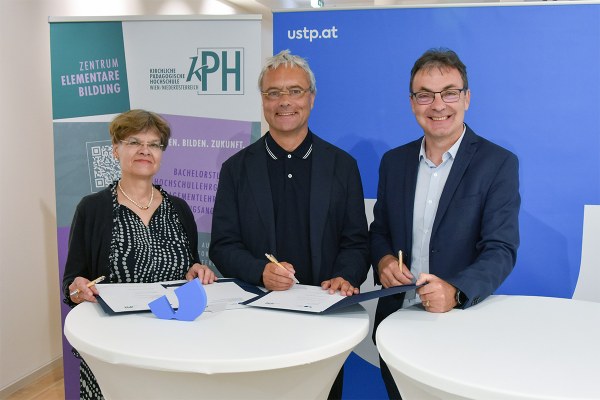 Credit: Thomas Immervoll
New Cooperation Agreement with KPH Vienna/Lower Austria
USTP already relies on a broad network of regional, national and international partnerships. By signing a cooperation agreement, this network has now been formally expanded to include KPH Vienna/Lower Austria. KPH Vienna/Lower Austria offers a bachelor degree programme in Early Childhood Education, as well as a range of continuing professional education programmes in the field of early childhood education, including Inclusive Early Childhood Education, Early Language Support, and a Higher Education Programme in Management.
"Quality in early childhood education cannot be achieved in isolation. It requires dialogue and a shared focus on practice and trust between institutions. Educational research clearly shows that the professional support of early learning processes has a decisive impact on educational success and opportunities for participation. For this reason, it is a key priority for us to continuously strengthen our commitment to the education and professional development of early childhood professionals and leaders through strong partnerships," emphasises Ulrike Greiner, Rector of KPH Vienna/Lower Austria.
Mayor Matthias Stadler, who was represented at the round table by the city’s Councillor for Culture and Education Birgit Becker, stated: "The quality of early childhood education is a shared responsibility. Successfully addressing the challenges facing early childhood education requires exchange and collaboration across institutional boundaries. The fact that so many committed partners in St. Pölten work together and build networks to shape the future of early childhood education sends a strong signal for the region as a centre of education and for the next generation."
Milestones for the Future of Early Childhood Education
The discussion focused on current developments and opportunities in early childhood education, as well as the potential of cross-institutional cooperation. The experts involved Christine Schmid (Head of the Early Childhood Education¹ degree programme, USTP), Astrid Kircher (Head of the Centre for Early Childhood Education, KPH Vienna/Lower Austria), Simone Breit (Head of the Department of Early Childhood Education, University College of Teacher Education Lower Austria), Nina Hover-Reisner (Head of the degree programme in Social Management in Early Childhood Education, Hochschule Campus Wien), and Silvia Forstner (Province of Lower Austria, Department K4_5). The speakers highlighted the requirements facing future professionals and discussed the further development of education and training, research, and professional practice to ensure the quality and long-term sustainability of early childhood education.
More information on the study programmes offered can be found here:
- USTP study programme in early childhood education
- Study programme in early childhood education at the Private University College of Teacher Education of Christian Churches Austria
- HCW study programmes in early childhood education
- Study programmes in early childhood education by the University College of Teacher Education Lower Austria
1 subject to accreditation by AQ Austria
About the USTP CityLounge
The USTP CityLounge is an open community space run by USTP at the heart of St. Pölten’s city centre. Guided by the motto “Wissen.schafft.Wohnzimmer” (“A Living Room for Science”), it makes science, research and innovation accessible and engaging for everyone. Located at Wiener Straße 9, the CityLounge offers visitors the opportunity to connect with students and researchers, explore exciting projects, and gain fresh perspectives on the key challenges and opportunities shaping our future. The USTP CityLounge provides a welcoming space for dialogue, inspiration and the exchange of ideas.
FH-Prof. Dr. Katharina Auer-Voigtländer , BA MA
Head of Department Academic Director Social Work (MA) Continuing Education Officer Department for Social Sciences Course Leader Addiction Counselling and Prevention (acad.) Course Leader Addiction Counselling and Prevention (certif.) Course Leader Addiction Counselling and Prevention (MA) Course Leader Mental Health (acad.) Course Leader Mental Health (certif.) Course Leader Mental Health (MA) Researcher Ilse Arlt Institute for Social Inclusion Research Member of the UAS Board from 2023 to 2026 Department of Social Sciences
FH-Prof. Christine Schmid , MA
Academic Director Social Pedagogy (BA) Academic Director Young Childhood Education* (BA) Course Leader Social Pedagogy (acad.) Course Leader Social Pedagogy (Focus on Social Work) (BA (CE)) Course Leader Social Pedagogy (MA) Department of Social Sciences
Sandra Lagler , BA, MA
Expert Video Production und Corporate CommunicationsMarketing and Communications
