
Study: AI-Optimised Reporting
How Companies Triple Their Visibility in ChatGPT

Copyright: nexxar
More and more people are using AI-supported systems such as ChatGPT to quickly and easily obtain information about companies. This raises the question of how visible companies are in such applications and what content users actually find about them there. Our current study shows which factors determine whether and how companies are present in AI-generated answers.
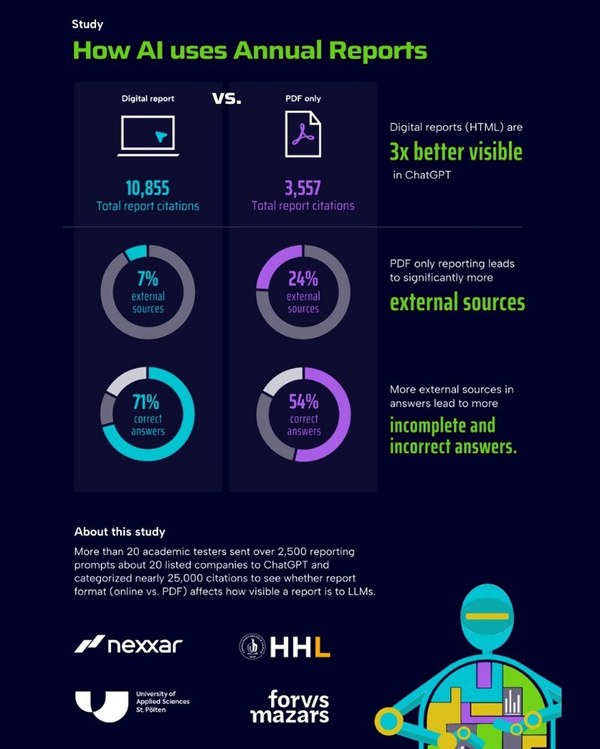
The file format is a decisive factor. Companies that publish their annual reports in HTML format appear three times more often in ChatGPT responses than those that rely on PDFs. In addition, an HTML source leads to factually more accurate statements by the artificial intelligence (AI). These and other conclusions are drawn by the large-scale study “AI optimized Reporting” conducted by the USTP – University of Applied Sciences St. Pölten, the HHL Leipzig Graduate School of Management, and the Vienna-based online agency nexxar. For the first time, it provides companies with data-based insights on how to prepare their verified financial data so that they are used as a source by the AI language model ChatGPT.
Copyright: nexxar
ChatGPT as the foundation for investment decisions
Almost half (47 percent) of all private investors use AI tools such as ChatGPT in order to interpret financial data or prepare investment decisions. This is the result of an analysis published by the University of Washington at the end of 2024. Users particularly appreciate AI’s ability to break down complex data volumes in seconds. At the same time, however, more than half (54 percent) of the respondents expressed their doubts about the reliability of AI-generated answers.
Which Sources of Information Does ChatGPT Use?
This concern is justified, finds the research trio from St. Pölten, Leipzig, and Vienna. Between September and November 2025, the team of 20 members from USTP – University of Applied Sciences St. Pölten analysed more than 2,500 prompts and answers pertaining to, for example, annual financial statements, management remunerations, and sustainability topics for 20 publicly listed companies. In this context, the team categorised and analysed more than 24,000 sources used by GPT-4o and GPT-5.
The result: In 85 percent of cases, the AI language model refers to the companies’ own content such as verified business reports (58 percent), investors relations websites (15 percent), or company websites (12 percent). As for the remaining 15 percent, the AI chatbot relies on external sources such as financial data providers (six percent) or media reports (three percent).
File Format as Factor: Three Times More Visibility for HTML
Whether ChatGPT uses the verified original data or falls back on secondary data sources depends to a large extent on the company source’s file format: The study shows that HTML reports (that is, online business reports) are three times more likely to appear in the answers given by AI chatbots than PDF publications. While ChatGPT falls back on external sources for almost a fourth of cases (24 percent) in the event of PDF reporting, this share is reduced to seven percent when reports are available in HTML.
“Large language models such as ChatGPT prefer structured data. They extract data much faster and more precisely from HTML code than from PDF files”, explains Monika Kovarova-Simecek, Academic Director of the master degree programme Digital Business Communications at USTP which offers the framework for the research project.
Fact Check: Less Misinformation in HTML
An additional fact check of approximately 200 further ChatGPT answers regarding business reports shows quality defects that can have consequences for potential investors in particular: Only 63 percent of AI statements are both complete and correct, while a fourth remains incomplete and 20 percent even contain misinformation.
What is striking is the difference in quality depending on the source: In 71 percent of all cases, HTML reports lead to correct results – for PDF reports, it is only 54 percent. “This makes it all the more important for companies to avoid putting technical obstacles in AI’s way. When machine-readable data is lacking and ChatGPT has to fall back on external third-party sources instead, the risk of misinformation increases”, warns Eloy Barrantes from the reporting agency nexxar. “In other words, business reports need to be accessible, that is, as machine-readable as possible.”
What Do Potential Investors Ask ChatGPT?
In parallel with the content analysis, the research team of HHL Leipzig also analysed the server protocols of five DAX-listed companies in order to find out which bots most frequently access digital business reports. The result: Among almost five million automated accesses and over 100 identified bots, ChatGPT dominates with a share of more than 30 percent.
Moreover, the analysis of over a million concrete ChatGPT prompts demonstrated the following profile of interests: Users questioned the AI language models primarily concerning operative business development, corporate strategy, and financial and sustainability indicators.
“ChatGPT uses digital business reports as comprehensive sources of information on a company’s development. For companies, this means: Those that process their data in an AI-oriented manner can determine what potential investors can read about them”, summarises Henning Zülch, professor for accounting, auditing, and controlling at HHL.
