Open Access at USTP – University of Applied Sciences St. Pölten
As a signatory of the Berlin Declaration on Open Access to Knowledge in the Sciences and Humanities, USTP is committed to advancing sustained Open Access to scholarly publications. To this end, USTP encourages and supports all its employees and researchers to make their research results freely available by providing funding, a repository for self-archiving, and legal support regarding copyright and licensing.
Should you have any queries, please contact Jonas Kerschner (library) for further information.
FAQ - frequently asked questions / copyright and licenses
Gold Open Access and Green Open Access
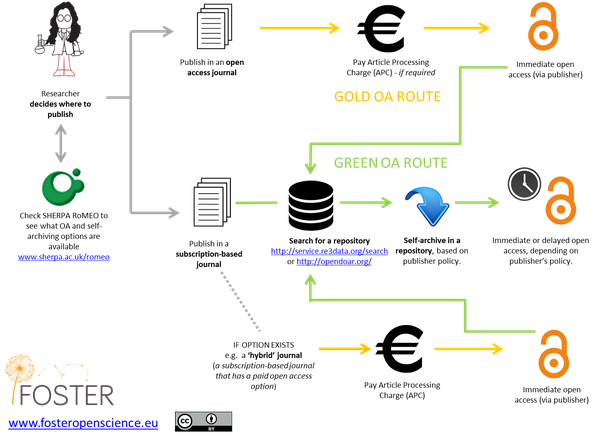
Gold Open Access (immediate Open Access) and Green Open Access (delayed Open Access) are the two main routes of Open Access publishing.
With Gold Open Access, paying an Article Processing Charge (APC) ensures that the item is instantly available worldwide at no extra cost.
Green Open Access denotes the secondary publication or self-archiving of scientific literature in an institutional or subject-specific repository (taking into account the respective publisher's conditions, which can be checked via Open Policy Finder (formerly Sherpa services)).
Hybrid Open Access is a mix between Gold and Green Open Access.
The following visualisation illustrates the three main routes of Open Access publishing of scientific journal articles:
Availability of own scientific work for the entire scientific community
Improved visibility and thus increased citation count
Free worldwide access to the work of colleagues
Increased scientific exchange and more feedback
Better reusability of scientific results
More exploitation rights (and thus greater freedom of design) remain with the authors
Less dependence on publishers and more transparency and competition in scientific publishing
The public gains access to the results of scientific research
What are free licenses?
Copyrighted works are subject to the so-called moral rights and exploitation rights. In contrast to the personal rights, the exploitation rights are transferable (§ 24 UrhG (1)). A distinction is made between the usufruct (non-exclusive right to use the work) and the right of use (exclusive right to use the work). In publishing contracts usually rights of use are granted, so that the authors themselves have no exploitation rights.
With a free license, the author grants the users a work license. Content under a free license remains protected by copyright, but may be used within the scope of the respective license terms.
What are Creative Commons?
In order to ensure the legally clear and correct formulation of the license terms of free licenses, the organization Creative Commons was founded in 2001. The licenses, which were developed by Creative Commons and are freely available, allow the author to grant the user certain rights of exploitation as part of a work use permit, such as commercial or non-commercial use or further processing.
How do I recognise a Creative Commons (CC) license?
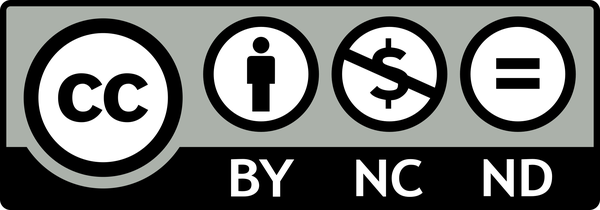
Documents with a Creative Commons license usually have the logo of the respective license as well as a text note on the license type and a link to the complete license text on the title page.
Example: This work is licensed under the Creative Commons Attribution-NonCommercial-NoDerivatives 4.0 International License. To view a copy of this license, visit http://creativecommons.org/licenses/by-nc-nd/4.0/.
Which Creative Commons (CC) licenses are there?
There are a total of six different licenses, which consist of four different modules. The four modules are:
BY = attribution - The author and other parties designated to receive attribution must be named.
NC = non-commercial - The work may not be used for commercial purposes.
ND = no-derivatives - The work may not be changed, adaptations of the work are not permitted.
SA = share alike - The newly created or adapted work must be passed on under the same license.
This results in the following six licenses:
CC BY: Attribution
CC BY-SA: Attribution-Share-Alike
CC BY-ND: Attribution-No-Derivatives
CC BY-NC: Attribution-Non-Commercial
CC BY-NC-SA: Attribution-NonCommercial-ShareAlike
CC BY-NC-ND: Attribution-NonCommercial-ShareAlike-NoDerivatives
More information about the individual licenses as well as the links to the abstracts and legal long versions can be found here.
What are the advantages of CC licenses?
The biggest advantage for the author / creator is the widest possible dissemination of their work. Works under a CC license are freely searchable on the net, thus increasing the visibility and the probability that the work will be cited. In addition, by assigning a specific CC license, the author has the decision and control over what can be done with the work. The advantage for the user is, in addition to the free accessibility of the works, having exact knowledge as to which rights are granted and which are not. Both sides benefit from a high degree of legal certainty.
How can I prevent violations against the conditions set by my CC license?
Complaints for copyright infringement are possible in the context of the CC-licenses as with any other copyright license. Thus, CC-licensed works are subject to the same legal protection as works that are fully protected by copyright.
How can I publish under a Creative Commons license?
The first prerequisite is that it is a "work" in the legal sense, so that the copyright applies. In addition, you must be a holder of rights to the work: You must be the author / creator and may not have given the exploitation rights, for example, to a publisher. Co-authors must also agree to the licensing with a CC license.
If you meet these requirements, you can assign your work a CC license. The license is granted by inserting the logo of the respective license and the corresponding text note including the link to the license in your document.
On the Creative Commons website you will find help on choosing a license and the logos to download.
How do I cite a CC-licensed publication correctly?
The CC license must be specified as well as copyright and title. In the case of a print publication, the mention of the license suffices; in the case of an online publication, the link to the license must also be inserted. If the work has been edited, this must also be indicated.
Since there were country-specific versions for the CC licenses prior to the current 4.0 version, which were adapted to the respective state laws, the corresponding country code must also be specified for CC licenses up to version 3.0.
Example for quoting a journal article:
Author, Title. In: Journal Name 12 (2012), 12-24, DOI: 10.1016/example.2012.12.024, CC BY-NC-ND 3.0
"Fake Journals" and "Predatory Publishing" are dubious business models by publishers and journals, which charge the authors money for services not provided. Quality control, such as peer review, is poor or non-existent. Reliable long-term availability of the articles is not guaranteed. Often, scientists are named as publishers without their consent. In addition to fake journals, there are also fake conferences.
Most fake journals cannot be clearly identified as such on the basis of individual characteristics. It is necessary to look at various characteristics in order to determine whether the journal in question is a predatory journal. It is recommended that you regularly check on the internet to see whether you are the publisher of a journal without your knowledge and consent.
Tip
Use the following tools to check if it is a legitimate or predatory journal:
the Directory of Open Access Journals DOAJ lists all quality, peer-reviewed, open access scholarly research journals which have been checked for quality and legitimacy on the basis of numerous criteria.
The Open Access Scholarly Publishers Association (OASPA) provides a list of legitimate Open Access publishers, which are included as members following a rigorous review process and are regularly reviewed for compliance with the required quality criteria.
Open Access Publishing Agreements at USTP
In cooperation with E-Medien Österreich (KEMÖ), consortium agreements are concluded with publishers to facilitate the publication of Open Access articles in journals. Individual solutions for other publishers can be arranged after consultation with project managers or supervisors. The range of discounted Open Access publication options at USTP is currently being expanded and developed
Tip
Please direct any queries regarding further Open Access publishing options to Jonas Kerschner (Library)
The Association for Computing Machinery (ACM)
The Association for Computing Machinery (ACM) and the Austrian Academic Library Consortium (KEMÖ) have arranged an unlimited Open-Access Read and Publish agreement for the first time starting from January 2022 to December 2024, which will enable corresponding authors, affiliated with the institutions mentioned below, also to publish open access free of charge.
Duration: 01.01.2025–31.12.2029
Elsevier
Elsevier and the E-Medien Österreich (KEMÖ) cooperation have concluded a Read and Publish agreement for the years 2024 to 2026. This agreement offers eligible authors from participating institutions the possibility to publish Open Access in the publisher's Gold and Hybrid journals without additional fees.
Duration: 01.01.2024–31.12.2026
Frontiers
The publication agreement with the Gold OA publisher Frontiers enables USTP researchers to publish Open Access in approximately 60 of the publisher's journals in a straightforward manner. In addition to simplified publication workflows, USTP benefits from a 10% national discount on Open Access publication fees specified in the agreement. Through this agreement, the article processing charges for FWF projects can be covered by the FWF. The list of journals can be found at the Frontiers OA Journals link
Members of our institution receive a 20% discount on article processing charges (APCs) in all participating journals of this publisher. To claim the discount, it is mandatory to state your institutional affiliation with USTP at the time of submission. The agreement covers all article types and specifies CC BY as the standard license. Furthermore, self-archiving of the author accepted manuscript (AAM) in the institutional repository is permitted without an embargo period.
Institute of Electrical and Electronics Engineers Inc. (IEEE)
IEEE (Institute of Electrical and Electronics Engineers) and the E-Medien Österreich (KEMÖ) cooperation have entered into an agreement for the years 2025 to 2027. This offers authors of participating institutions the opportunity to publish Open Access in the publisher's Gold and Hybrid journals without additional fees.
Duration: 01.01.2025–31.12.2027
IWA Publishing
As of January 1, 2025, the International Water Association (IWA) and the E-Medien Österreich (KEMÖ) cooperation have entered into a three-year agreement that combines the licensing of IWA content with the option to publish Open Access. Members of the listed institutions are permitted to publish Open Access within the publisher's portfolio without additional fees under this framework. Information regarding the article submission workflow can be found via the IWA Publication Workflow link.
Multidisciplinary Digital Publishing Institute (MDPI)
MDPI AG (MDPI) and the E-Medien Österreich (KEMÖ) cooperation have concluded a new agreement based on a discount model. Eligible authors of participating institutions receive a discount of either 30% or 20% on the applicable fees.
Duration: 01.01.2025–31.12.2027
Oxford University Press (OUP)
The E-Medien Österreich (KEMÖ) cooperation and Oxford University Press (OUP) have concluded a Read & Publish agreement for the years 2023 to 2027. This agreement provides eligible authors of participating institutions the opportunity to publish Open Access in the publisher's Gold and Hybrid journals without additional fees.
Duration: 01.01.2023–31.12.2027
Sage
SSAGE and the library consortium in Austria have concluded a Read & Publish agreement with a term from 2023 to 2026. A component of this agreement is the ability to publish Open Access without additional fees, where eligible authors of participating institutions can publish in the Hybrid Journals of the SAGE Choice program within the journal packages their institution subscribes to. Additionally, an increasing discount is granted for publications in Gold Open Access journals over the duration of the term. The FHW Fachhochschul-Studiengänge Betriebs- und Forschungseinrichtungen der Wiener Wirtschaft GmbH is excluded from this specific agreement and remains under the previous model, where corresponding authors can publish in SAGE HSS Collection journals at significantly reduced APCs. A discount is also granted for their publications in Gold Open Access journals.
Springer and the Austrian library consortium have renewed the SpringerCompact licensing model from 2024 to 2026. This model combines the use of content on SpringerLink with the option to publish Open Access. In addition to reading access to over 2,000 Springer journals, eligible authors of participating institutions can publish Open Access in over 2,000 subscription journals without additional fees.
USTP provides two seperate Open Access funds to to help USTP-affilated authors cover Article Processing Charges (APCs) for Open Access publications in academic journals. In order to make use of these funds, the following criteria must be met:
FWF Open-Access Block Grant
As of January 1, 2024, the validation of Open Access publishing of works (peer-reviewed journal articles, contributions to edited volumes, etc.), that are wholly or partly funded by FWF projects, will be supported by an Open-Access Block Grant. The funding is administered by the Campus-Library of St. Pölten University of Applied Sciences.
Before submitting a manuscript resulting from an FWF funded project, please contact the Campus-Library (bibilothek@ustp.at // Jonas.Kerschner@ustp.at) to ensure that mandatory criteria of the FWF Open Access Policy are met.
Refunds are not possible. Invoices must be paid directly by the Campus-Library.
Funding requirements:
Journal must be a in DOAJ listed Gold- or Diamond OA journal
or
USTP has and active transformative OA agreement with the publisher
Corresponding author must be affiliated with USTP
CC BY license is obligatory Open Access publications from FWF-funded projects must bear the CC BY license (other licenses such as e.g. CC BY-NC or CC BY-ND are not compliant).
FWF acknowledgement mandatory The following statement must be included in all publications upon submission:
For publications in English :“This research was funded in whole or in part by the Austrian Science Fund (FWF) [grant DOI]. For open access purposes, the author has applied a CC BY public copyright license to any author accepted manuscript version arising from this submission.”
For Publications in German: „Diese Forschung wurde gänzlich oder teilweise durch den Wissenschaftsfonds FWF finanziert [Grant-DOI]. Zum Zweck des freien Zugangs hat der:die Autor:in für jedwede akzeptierte Manuskriptversion, die sich aus dieser Einreichung ergibt, eine „Creative Commons Attribution CC BY“-Lizenz vergeben.“
USTP Publication Fund
The following criteria must be met to receive funding from the USTP Publication Fund:
The author is
under a true employment agreement with USTP, listing USTP as their affiliation
the corresponding author of the publication in question
The publication is an academic journal article that meets the following quality criteria:
Publications in subscription journals (Hybrid Open Access): The journal in question is a peer-reviewed academic journal. (The review for eligibility is done by the library.).
No funding can be awarded if the publication fees are already covered by third-party funding, (e.g. via the FWF Austrian Science Fund). You can find further information on refunds of publications costs through the FWF Austrian Science Fund here.
The Open Access publication is subject to a Creative Commons license, ideally with a CC BY license (Attribution).
The funding available is distributed on a first come, first served basis. Funding cannot be reserved for a later point in time, requested retroactively, or be provided to cover fees that have already been paid.
Funding from the USTP Publication Fund may only be used for covering Article Processing Charges (APCs). No funding can be provided for covering other or additional expenses, for instance color printing charges.
The funding awarded to a publication is limited to a maximum of EUR 2,200.–. The amount awarded depends on the applicable Article Processing Charges (APCs). If the gross total APC exceeds the EUR 2,200.– limit, a maximum of EUR 2,200.– per article can be obtained from the publication fund. In this case, the applicant needs to submit an email indicating the internal account number that will cover the rest of the charges.
Awarding process
Please contact the library, who will tell you if your publication is eligible for funding from the USTP Publication Fund. If your application is accepted, you will receive further information on how to manage the payment of the invoice.
If your application is accepted and the amount applied for does not exceed EUR 2,000.–, the Article Processing Charge is paid in full by the USTP Publication Fund.
If your application is accepted and the amount applied for does not exceed EUR 2,000.–, the Article Processing Charge is paid in full by the USTP Publication Fund.
If your application is accepted and the total Article Processing Charge exceeds EUR 2,000.– the USTP Publication Fund contributes EUR 2,000.– to the total charge. In this case, the applicant has to submit an email indicating the internal account number that will cover the rest of the charge.
The library will carry out all the steps required for processing the invoice. In case of a split payment, the library will carry out all the required steps for charging the remainder of the charges to the internal account number indicated by the applicant.
Self-archiving via our institutional repository Phaidra
Our institutional repository Phaidra contains research output created at USTP, ranging from student theses to peer-reviewed publications and accompanying research data.
You can access our institutional repository Phaidra here.
For any question on how to upload, download, or restrict your uploaded work on Phaidra, please contact the library.
Glossary
Article Processing Charges (APC): fees for the publication of open access publications
Creative Commons licenses: alternative public copyright licenses. Authors retain rights to their work and permit different, non-exclusive use
Embargo: period after which a secondary publication (contractual or statutory) is permitted
Exploitation rights: exclusive rights of the author of a work to reproduce, distribute and make the work available
Persistent Identifier: permanent reference to a digital object (e. g. DOI, URN, Handle), which enables reliable discovery of digital objects
Publishing agreement: agreements with publishers for the open access publication of journal articles on reduced or special conditions
Repository: central storage location (server) for publications and / or research data
Self-Archiving: filing copies of a publication on publicly accessible websites, repositories, etc.
Version: pre-print (author's manuscript at the time of submission), post-print (version after peer review or publisher corrections), publisher's version (version in the publisher's layout)
Second publication right: right to republish already published works under certain conditions