
From Course Project to Academic Conference
Students developed an analysis tool for PEUAFLEU and had their first research paper accepted at an international conference
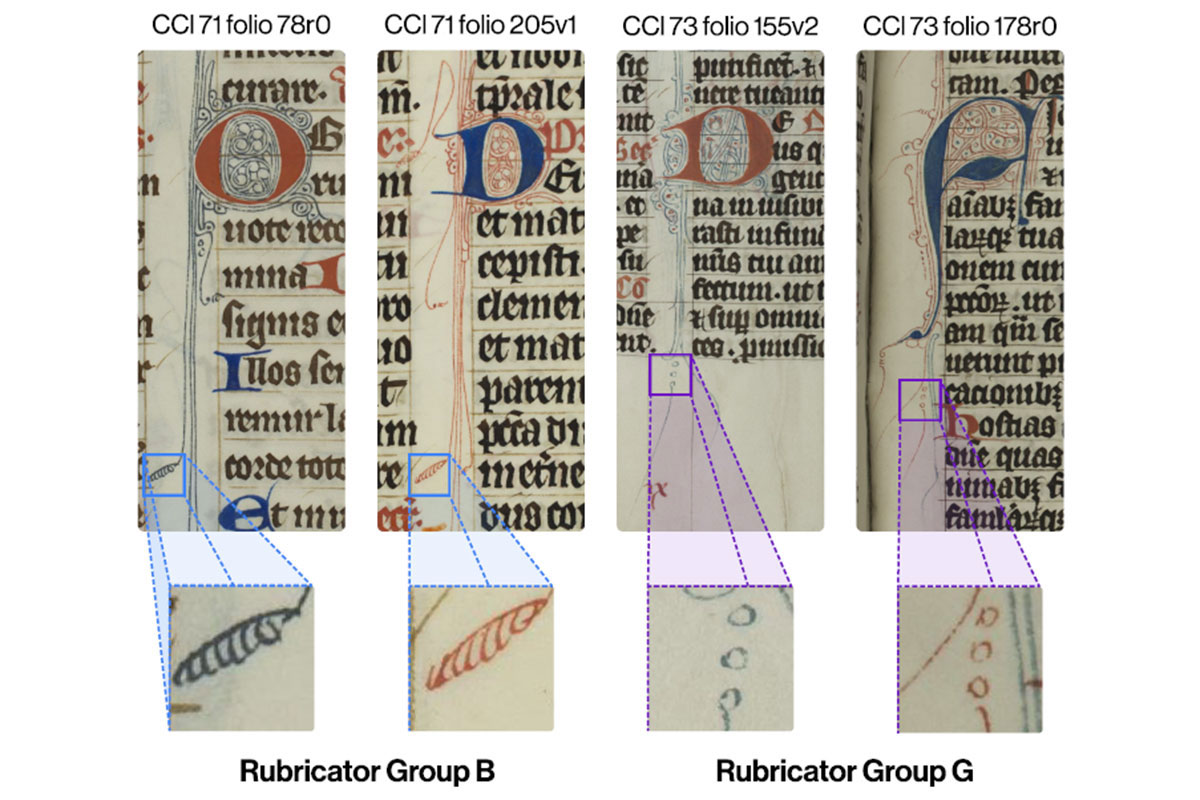
A course project that exceeded all expectations: during last semester’s mediaLab, students from the Creative Computing degree programme developed a tool for the USTP research project PEUAFLEU, which uses artificial intelligence to analyse medieval book ornamentation. Their project work led to more than just a good grade: the students wrote and submitted a research paper and had it accepted for the Content-Based Multimedia Indexing Conference (CBMI), an international conference on multimedia content analysis.
Fleuronnée Meets Computer Vision
The PEUAFLEU project focuses on a form of ornamentation known as fleuronnée. These pen-drawn tendrils, leaves and flowers decorate medieval manuscripts from the Klosterneuburg Abbey. Until now, researchers wishing to analyse the stylistic features of these ornaments have had to rely on painstaking manual comparisons.
The students’ task in the mediaLab was to develop a tool capable of automatically detecting fleuronnée and comparing its stylistic features. Their work contributes to the broader research question of whether connections between 14th-century scriptoria and libraries can be identified.
From Project Work to Conference Paper
Rather than bringing their work to an end when they submitted their course project, the students turned their findings into a research paper. With the support of researchers from the Department of Media and Digital Technologies, they submitted the paper to the CBMI and were successful. Congratulations!
The mediaLab and the academic publication were supervised by Djordje Slijepcevic, Mohammed Chegini, Florian Kibler, Andreas Babic and Matthias Zeppelzauer from the Institute of Creative\Media/Technologies (IC\M/T). For the institute, the paper’s acceptance is further evidence of how closely teaching and research are intertwined at USTP. Students do not simply work on set exercises but engage with genuine, open research questions and present their findings to the international research community.
