
Groundbreaking Ceremony for European Campus Hainburg
Future Project for Education, Research, and Innovation to Start in Summer 2028
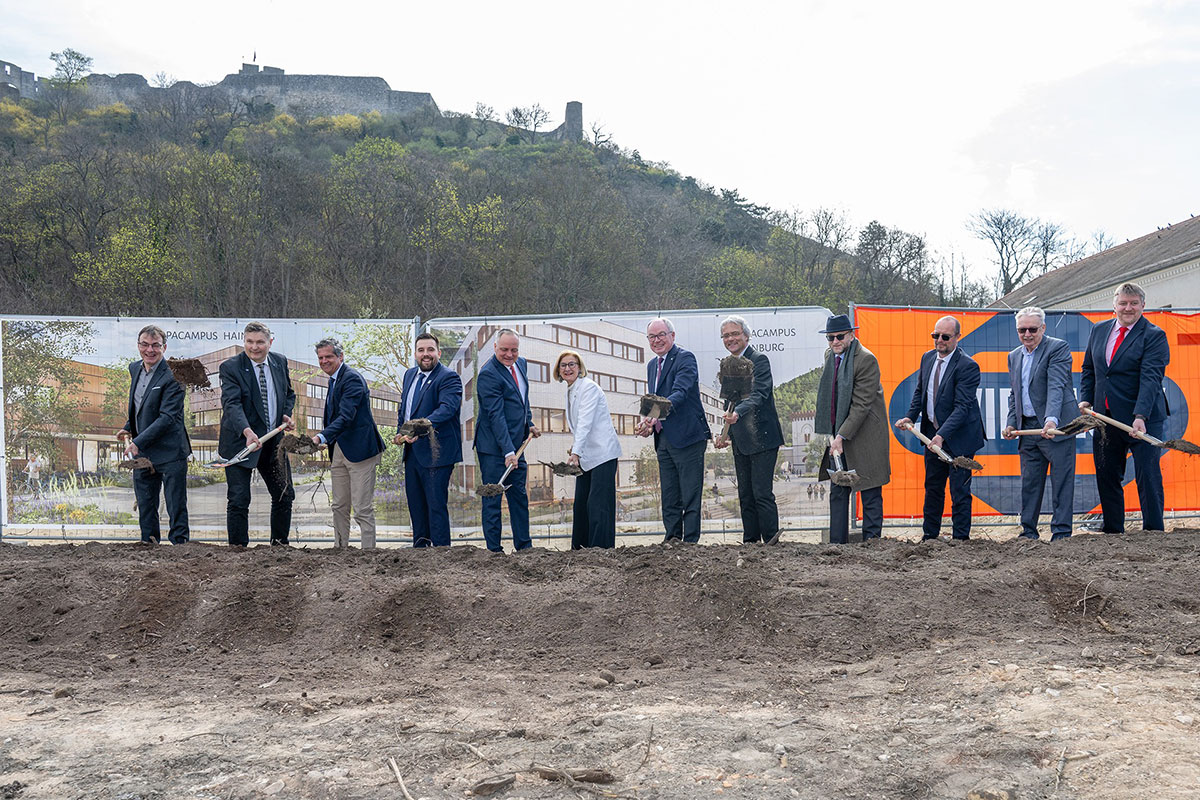
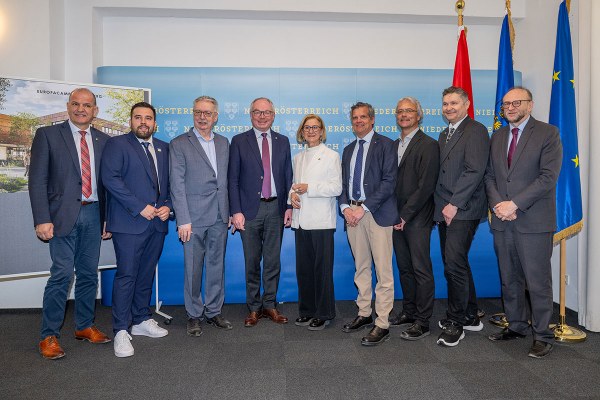
This Monday, the groundbreaking ceremony for the European Campus Hainburg (ECH) was held together with Governor Johanna Mikl-Leitner, Deputy Governor Stephan Pernkopf, Mayor Johannes Gumprecht, Jens Schneider (Rector of TU Wien), and Eduard Halmschlager (property owner and project developer). USTP was represented by Hannes Raffaseder, Johann Haag, Franz Fidler, and Jiri Nantl.
The ECH will be built over the next two years and is to be opened in the summer of 2028.
New Centre of Knowledge
“Today is a truly important day. You can feel it: Something big is in the making here in Hainburg. Something with an impact far beyond the borders of Lower Austria”, Governor Johanna Mikl-Leitner said during a press conference following the groundbreaking ceremony. “We are breaking ground here not just for a building but for a new centre of knowledge, for new opportunities, and for a strong future for this region and Lower Austria.”
“The European Campus Hainburg will be a place where ideas are turned into concrete solutions for the future”, she explained and added that this campus is “a central project in line with our economic strategy 2030+ and our higher education strategy 2030+. This project emphasises our aspiration: to turn Lower Austrian into one of the most innovative and research-oriented locations in all of Europe.”
 Copyright: NLK Burchhart
Leading Role for USTP
USTP – University of Applied Sciences St. Pölten will take over a leading role in the European Campus Hainburg. Along the new thematic focus, USTP will develop study programmes and offer them from the winter semester 2028/29. Eventually, almost 500 students shall be able to complete a study programme or continuing education offer at the new location. A close collaboration with TU Wien was announced as early as last summer, and further higher education institutions are to be involved as well.
USTP CEO Hannes Raffaseder: “The European Campus Hainburg offers the unique opportunity to establish a pioneering hub for excellently trained talents, creative ideas, and future-oriented solutions to today’s pressing problems. Through its extremely successful development and good positioning as the coordinator of the European University Alliance E³UDRES², USTP – University of Applied Sciences St. Pölten can contribute valuable experiences in interdisciplinary collaboration, the establishment of innovative teaching and learning scenarios, the lively mediation of relevant future competencies, the close interconnection of education and further training, applied research and knowledge transfer, and the cooperation with businesses and society. Together with all partners, we want to turn the European Campus Hainburg into an exemplary lighthouse for the university of the future which will decisively shape the cross-border region true to the motto ‘Local Pulse, Global Waves!’ and radiate far beyond the region at the same time.”
Research on Central Future Topics
At the ECH, experts will conduct research on central future topics and work on green technologies and smart regions. According to Governor Mikl-Leitner, the objective is clear: “In Hainburg, new technologies will be developed that will solve real-world problems – for the good of society. In short: The future will be shaped here, rather than just discussed.”
Construction on the ECH will start in June 2026, and its completion is scheduled for the summer of 2028. “A very ambitious endeavour – approximately 90 to 100 million euros will be invested in the construction, borne by private investors. The province of Lower Austria, in turn, will invest 19 million euros in the research labs’ equipment and will also provide the financial means for ongoing operations”, explained Mikl-Leitner.
Roughly 480 students will receive an education here, and approximately 200 research jobs will be created. “For the region, this campus means more jobs, more value creation, more prosperity. In other words, a lighthouse project”, she said, adding that she was particularly proud of the cooperation with TU Wien and with USTP – University of Applied Sciences St. Pölten because they give the campus a European dimension through their European alliances. “In this way, the ECH will live up to its name ‘European Campus’”, the Governor stated.
Science and Research for a Better Life
Deputy Governor Stephan Pernkopf highlighted that “science and research are meant to improve the lives of people in Lower Austria. Our universities of applied sciences and other educational institutions are already doing that. Here in Hainburg, we are creating another education and research centre that is extremely important for the future of our province.”
It takes centres like this to attract talent and generate knowledge. “We try to create the best infrastructure and we establish an environment where the future can develop. This is not just about abstract science but about being able to apply it in everyday life”, he said and added: “Here at the European Campus Hainburg, we want to create a centre whose impact goes beyond the region. In research and science in particular, it is true that the better and more intensive the collaboration is, the better the results it delivers. Instead of predicting the future, we need to make it possible. This is what the ECH is all about.”
 Copyright: CHP Rendering
Internationally Oriented Centre for Education and Research
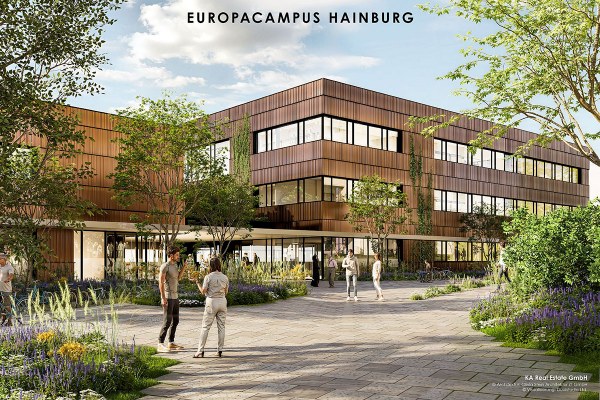
The European Campus Hainburg stands for a new dimension of cooperation between universities, universities of applied sciences, and research institutions. The goal is to create an internationally oriented centre of education and research with a focus on future topics such as green technologies, sustainable innovations, and applied science.
Jens Schneider, Rector of TU Wien, explained: “Just like TU Wien, the European Campus Hainburg stands for the close connection between scientific excellence and social impact. It facilitates an environment where research insights are systematically translated into innovative applications – in close exchange with partners in science, business, and society – and across national borders. Its strong European network opens up new horizons, which makes the campus a starting point for forward-looking developments in Europe.”
Read more about the European Campus Hainburg (New from December 2025)
