
Breadcrumbs
More FAQ
Master programme Citizen-Centered Digital Health and Social CarePlease note: All information on this website is provided for general guidance only and is subject to change without notice. It does not constitute a legally binding commitment or offer.
General Questions on Studying
What are these studies and degrees all about?
This E³UDRES² Joint Master’s Programme, Citizen-Centered Digital Health and Social Care, has been jointly developed by St. Pölten (Austria), Saxion (the Netherlands), and Jamk (Finland) Universities of Applied Sciences as members of the E³UDRES² (Engaged and Entrepreneurial European University as Driver for European Smart and Sustainable Regions) alliance. The programme emphasises the interdisciplinary development of technology-driven innovations in the healthcare sector. All graduates receive multiple diploma's: a joint Master of Science degree from St. Pölten and Saxion, as well as a separate master’s degree from Jamk based on your bachelor’s degree subject (according to Finnish regulations, e.g., Bachelor of Nursing > Master of Health Care; Bachelor of Engineering > Master of Engineering).
This master's degree is on EQF7 level. This level is described in the Framework for Qualifications of the European Higher Education Area and related to the Bologna process, further explained here: Description of the eight EQF levels | Europass
Find out more about the contents of the programme here.
Where and when will the studies take place?
You will study in three countries:
- The 1st semester, starting in September, will take place at USTP – University of Applied Sciences St. Pölten in Austria.
- The 2nd semester, starting in February the following year, will be held at Saxion University of Applied Sciences at Enschede in the Netherlands.
- The 3rd semester, starting in August the following year, will take place at Jamk University of Applied Sciences at Jyväskylä in Finland.
- During the 4th semester, you are not bound to a specific location. Courses, supervision and discussions can take place online. However, we expect you to be physically present in Austria at USTP – University of Applied Sciences for your final examination.
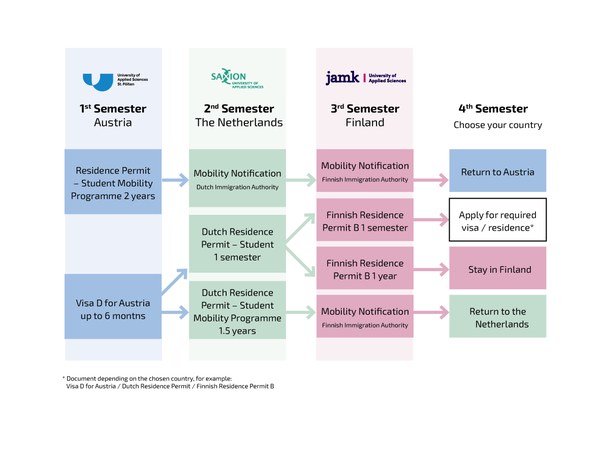
To Non-EU/ Non-EEA citizen we strongly recommend to spend your last semester at USTP – University of Applied Sciences St. Pölten in Austria. By doing so, you can obtain a Residence Permit – Student issued for up to 2 years for mobility programmes and study without additional residence permit applications.
Is this an online or on-campus programme?
This is a fully on-site programme, which may include online teaching. Physical mobility is an essential and mandatory part of the curriculum. You will study and live in three different countries during the programme. The Universities of Applied Sciences will offer help with arrangements.
How long will the studies last?
The studies are full-time and last for two academic years, divided over four semesters (120 ECTS in total).
What is the language of the studies?
The programme is taught entirely in English. All courses, materials, assignments, and communication with staff and mentors are conducted in English.
How many students are accepted per year?
There is an extensive application process to ensure the best suitable students are admitted. You will learn among students from multiple professions as communities of practice, which ensure a high-quality, personalised learning environment with close interaction between students, lecturers, citizens and partners from working life and industries.
Programme Details
Is the programme degree accredited and internationally recognised?
Yes. This is a Joint Master’s Programme, accredited under the European Approach for Quality Assurance of Joint Programmes. Graduates receive a master’s degree (EQF level 7) that is fully recognised across Europe and internationally. This level is described in the Framework for Qualifications of the European Higher Education Area and related to the Bologna process, further explained here: Description of the eight EQF levels | Europass.
What career opportunities will I have after graduation?
The graduates are equipped with advanced interdisciplinary skills to work on the development of innovative, people-centred solutions in leadership roles within the globally evolving healthcare sector. Typical roles include innovation manager, solution developer, project manager, application specialist, or researcher.
How much do I have to pay concerning fees related to the Programme?
Programme fees depend on your nationality:
- EU/EEA students: € 363.36 per semester
- Non-EU/EEA students: € 1500.00 per semester for students who, according to Austrian § 2 (2) Universities of Applied Science Act (FHG), do not belong to the groups of persons covered by the provisions of the responsible Federal Minister for these groups, and who have a residence permit for students pursuant to Austrian § 64 Settlement and Residence Act (NAG), Federal Law Gazette I no. 100/2005.
These fees apply to each of the four semesters of the programme and are paid to USTP. The Programme fee for the first semester is due immediately following the signature of the study contract (you can find further information in the section Admission and Enrolment Process).
The fees cover tuition, examination and administrative services provided by each academic institution. This contains participation in all courses of this Master’s Programme, access to university facilities, supervision, and support across all partner institutions. It does NOT cover accommodation, travel, insurance, deposits, copy costs, course literature, personal study material, excursions, study trips, optional subjects or voluntary programmes, conferences and symposia, or daily expenses.
There are additional compulsory fees. Students will have to pay
- a fee of approximately 26.20 EUR per semester for studying at USTP that will provide the Austrian Student’ Union (ÖH) fee including the ÖH accident and liability insurance.
- In addition, students need to pay health care fee for students in higher education, so that they can use the services of the Finnish Student Health Service (FSHS). The FSHS fee is paid to Kela and is due at the beginning of each semester. Students who have social security coverage in another EU or EEA country, Switzerland, Great Britain or Northern Ireland, do not have to pay the healthcare fee, but they need to notify KELA about it. After paying the health care fee or notifying Kela, you can use the services of the Finnish Student Health Service (FSHS).
After accepting the study contract, you will further have to pay a deposit of 100 EUR for your student ID card, which includes copying and printing up to the paid amount.
In addition, students can pay on a voluntary basis
- a Finnish Student’ Union fee which is approximately 24.50 EUR per semester. This is recommended for the duration of your stay in Finland, as the Student Union card entitles you to the different student discounts e.g. 50% discount from train tickets.
You are responsible for your own living expenses, including accommodation, travel between countries, national health and/or permanent travel insurance, and daily costs — these are not covered by the fees described in this section.
Are there any scholarships offered and how can I apply for them?
There are multiple options to support students with tuition or living costs:
Erasmus+
You are eligible to apply for an Erasmus+ grant for exchange periods at Saxion University of Applied Sciences in the Netherlands (2nd semester, eventually 4th) and at Jamk University of Applied Sciences in Finland (3rd semester, eventually 4th). Per study cycle a maximum funding duration of 360 days within the Erasmus+ programme is possible. The grant is about € 5 000–€ 7 000 for the whole time of studies, covering up to 360 days across 2-3 mobility semesters, depending on the destination country, length of stay, mode of transport, and the available funds.- Students who qualify for the Erasmus+ students with fewer opportunities category are eligible for extra top-ups. This category includes, for example, students with dependent children, or students with disabilities, and students with health conditions resulting in increased financial expenses.
- The Erasmus+ grant helps to cover part of travel and living expenses during the international study period. All eligible mobilities are intended to be supported. If the available Erasmus+ funds are insufficient, grants provided by USTP will be allocated according to the order of priorities mentioned on the USTP website: ''Grants for Stays Abroad & Mobility within the Framework of Studying''.
Students at Risk-Fonds (OeAD)
- This Fonds may be relevant for students who are enrolled in a Bachelor's, Master's or PhD/doctoral programme at a university outside the EU/EFTA* which is recognised in Austria. If your are demonstrably at risk of being formally or de facto denied the right to education at their university on the basis of their ethnic, sexual, gender or religious identity or their political or civic engagement, this fonds is intended to support you when continuing and completing your studies (only semesters with presence in Austria).
Funding options through your own governments
- Students are encouraged to explore funding options through their own governments or international scholarship portals. The most important resource is the Austrian national grant database, where students can search for relevant funding based on their country of origin.
Admission Criteria
What are the admission requirements?
You must have a bachelor’s degree in the field of health, social sciences, or technology sciences with two years’ work experience by the start of the study in this field. Please find more information about the accepted work experience below.
Which languages are accepted for attachments in the online application?
All attachments must be in English. Documents in languages other than English must be accompanied by a certified translation into English. Certified translation means that the translator must be authorised, in other words, a person who works as a legalised translator must translate the certificates. The translation must have the translators' signature and a stamp.
How do I prove my English proficiency?
Applicants whose native language is not English or whose undergraduate instruction was not in English must demonstrate proficiency in English by the application deadline. Accepted tests of English language competence (taken in a test center, not at home) are:
A minimum of
- TOEFL iBT80
- IELTS 6.0
or similar English language qualification for EU and NON-EU students (Cambridge English Language Assessment with a minimum score of 169, LanguageCert Academic with a minimum score of 65, Pearson PTE Academic with a minimum score of 61, and TOEIC, both listening and reading with a minimum score of 865 and speaking and writing with a minimum score of 335).
Based on your previous education, a similar English language qualification for EU-students could for example be your final grade in English from European upper secondary school with minimum level B2. In this case this official test is not required.
Non-native English speakers who fall in one of the following categories may request an English language proficiency waiver, for example:
- applicants from countries where English is one of several official languages,
- applicants who have obtained their undergraduate degree from an English-language university,
- applicants who, within the past five years, had spent a minimum of two consecutive academic years of study at a recognised English-language university or institution of higher education.
I have already one master’s degree. Can I apply for another one?
Yes, you can apply for the programme, even if you have an earlier Master’s degree (EQF level 7).
This master's degree is on EQF7 level. This level is described in the Framework for Qualifications of the European Higher Education Area and related to the Bologna process, further explained here: Description of the eight EQF levels | Europass
Can I apply as a Non-EU/EAA student?
Yes, you can apply as a Non-EU/EEA student. We strongly recommend that you carefully prepare and provide all the requirements documents for admission, visa and residence permit.
What kind of work experience is relevant?
The work experience must be in the field of the previous degree or in the field that the applicant is currently applying for. Also, work experience as an entrepreneur or as a freelancer will be accepted.
Practical training or on-the-job learning is not counted as work experience if it has been a part of the degree used for applying. Service in army, non-military service or parental leave is not considered as work experience.
How is work experience counted?
Applicants may include work experience gained up to the start of the programme. In other words, the first day of study is the final date by which the required work experience must be completed. If you don’t get the two years of work experience accumulated by the start of the programme in September, you are not eligible for this degree programme.
Part-time work can be converted into full-time equivalents: 150 hours or 20 full workdays (with a minimum of 7 hours per day) are considered equivalent to one month of full-time work. The working hours or working days per month must be clearly stated on the work certificate.
How can I verify my work experience?
The work experience must be verified with official work certificates. They should contain the following: your full name, job title or role, start and ed dates of employment, working hours or number of workdays per month, brief description of duties and responsibilities, company name and contact details, and signature and stamp.
If you have been working as an entrepreneur, you must submit a formal certificate confirming your business activity. This can be, for example, a certificate of registered business that states explicitly the operating field and the active period of the business is accepted, or a certificate of the completed assignments from your freelancing platform or the companies you have worked with.
If your employment continues up to the start of the programme, you may verify it by including a certificate from your employer confirming the ongoing nature of your work and its expected end date.
Application Process
Could you briefly explain how and when to apply?
Complete the online application form and attach the required documents via bewerbung.ustp.at during the application period. We recommend submitting early to receive notifications which you may use for providing any additional or missing documents. Your application will be checked for completeness and formal compliance with the admission requirements, as well as the quality of your application. You may be invited to participate in an online interview.
After the official application period has ended, delayed applications from the EU / EEA Area and Switzerland will be accepted as long as remaining places are still available.
All information, dates and deadlines for the application and admission procedure of your chosen study programme are available here.
Detailed information on the individual steps of the online application
Are there any application fees and when do I need to pay it?
Applicants from outside the EU, EEA or Switzerland are required to pay a deposit of 200 EUR to apply to higher education studies. It needs to be paid before the end of the application period. Payment is accepted via credit card; alternative options are possible. The application fee does not guarantee that you will be admitted to the studies and will be refunded.
The deposit regulations are available here: International Degree Seeking Students
How will I be contacted regarding the application process?
All communication regarding your application will be sent by email from the admissions office. Make sure to check your inbox regularly, including your spam or junk folder.
What are the requirements for the motivation letter?
Your motivation letter is an opportunity to show us who you are beyond your academic records and explain why you are a great fit for this Joint Master’s Programme. However, please make sure your letter is maximum one A4 page.
We encourage you to structure your letter around the following key areas:
1. Your academic & professional background
- What previous experiences have led you to apply for this programme?
- How have your studies, work, or personal projects prepared you for this programme?
2. Why this Master’s Programme?
- What excites you about this programme, and how does it align with your goals?
- Are there specific topics in citizens’ digital health that particularly interest you?
3. Your vision for the future
- How do you see yourself using the knowledge and skills from this programme in your career?
- Do you already have a field, industry, or type of project in mind for your master’s thesis?
Clarity and structure
- Ensure your letter is well-organised, clear, and logically structured.
- Keep it concise and personal, avoiding generic statements.
What is recommended regarding the project portfolio?
The portfolio is a file upload and by providing it, you have the opportunity to showcase your most relevant work, demonstrating your abilities and skills in health, social, or technology sciences, as well as your interdisciplinary experience and creative problem-solving.
Work/projects could be showcased with text/graphics in the file, and/or with links to online projects, videos, or repositories (e.g. to personal/project websites, Mahara, GitHub or others). Please always write out links and upload them in the form of a Word or PDF document.
Links must be available online, without download, using standard browsers. If your portfolio is a website, ensure that it is clearly structured and accessible and that your contribution is clear. Keep the explanation understandable and concise but informative.
You may show:
1. Project description and context
- What was the goal of the project? What problem were you trying to solve?
- Was this an individual project or part of a team?
2. Your role and contributions
- What specific responsibilities did you have?
- Which tasks did you personally work on?
- What approaches, methods, frameworks, tools, software, or technologies did you use?
3. Challenges and learning outcomes
- What difficulties did you encounter, and how did you overcome them?
- What did you learn from this project that will help you in your master’s studies?
4. Innovative approaches
- How (technically) advanced or innovative was the project?
- How was your approach unique or work/industry-relevant?
What to avoid?
- Portfolio items without clear attribution (e.g., just final images without an explanation of your role).
- Overloaded portfolios. Focus on quality over quantity; include few strong, well-documented elements instead of many without explanation.
- Unclear or inaccessible links—if hosting online, ensure your projects are public or provide access.
- Avoid overly technical or professional jargon, but ensure we understand your contributions.
What could be included in recommendation letters?
The provision of two recommendation letters is invited as an upload (both combined in one PDF file) offering you the opportunity to provide insight into your academic abilities, professional skills, and potential for success in this Joint Master’s Programme.
You can submit up to two letters of recommendation. We encourage you to select referees who know you well and can provide a detailed, personalised assessment of your qualifications.
Ideally, your letters would cover:
1. Credibility and strength of the reference
- The referee should clearly state their relationship to you (e.g., professor, supervisor, mentor).
- A strong letter provides specific examples of your skills, work ethic, and achievements, rather than generic statements.
2. Relevance to Citizen-Centered Digital Health and Social Care
- At least one letter should highlight your connection to citizen-centeredness, digital health or social care, innovation or creativity/problem-solving skills.
- If you do not have direct experience in digital health, your referee should explain how your background and skills make you a strong candidate for the programme.
3. Professional and academic perspective
- One letter can be from an academic referee (e.g., professor, thesis supervisor) discussing your research ability or academic potential.
- The second letter may come from a working life or industry professional (e.g., employer, mentor, supervisor) speaking about your professional skills, teamwork, or problem-solving abilities.
4. Structure & content
- The letter should be formal, signed, and on official letterhead if possible.
- It should have a max. length of one A4 page and provide specific details about your qualifications.
What to avoid?
- Letters that are vague or overly general (e.g., “The student is hardworking and motivated.”)
- Letters from personal contacts or family members. Recommendations should come from academic or professional sources.
- Copy-pasted templates. Your referees should take the time to write a personalised letter that reflects your strengths.
What is recommended regarding the video introduction?
Your personal video is invited as an URL uploaded in a PDF giving you an opportunity to introduce yourself beyond your written application. Please write out the link (e.g. to a shared personal cloud) and upload it in the form of a Word or PDF document. The link must be available online until the end of September, without requiring any downloads, accessible with commonly used browsers.
The video could highlight your motivation, background, and personal qualities that make you a great fit for this Joint Master’s Programme.
It may include:
1. Your background and journey
- Who are you, and what led you to apply for this programme?
- What relevant academic or professional experiences have shaped your interest in digital health?
2. Your fit for this programme
- What excites you about this programme?
- How do you see yourself contributing to the community of learners in this programme?
- Have you worked in citizen-centered, collaborative, multi- or interdisciplinary/-professional, or international environments before?
3. Your personal strengths and working style
- What role do you typically take in teams or projects? (e.g., leader, problem-solver, designer, researcher, developer, mentor, supervisor, coordinator)
- Can you share an example of a challenge you faced in a learning / development situation or project and how you approached it?
- How do you handle learning something completely new or working with new people?
Format and submission guidelines
- Length: Keep your video between 2–3 minutes.
- Style: No need for a highly produced video. Clarity and authenticity matter more than editing skills.
- Presentation: Speak clearly and naturally. This is about communication, not perfection.
- Language: The video must be in English to ensure your communication skills align with the programme.
What to avoid?
- Overly scripted videos. We want to see your personality and communication skills.
- Generic statements. Focus on specific experiences that highlight your strengths.
- A video that just repeats your motivation letter. This is your chance to add something new and personal.
Admission and Enrolment Process
Details on the admission process, application, requirements and deadlines can be found on the Master Programme website
What is the admission decision based on?
The admission decision is based on your academic quality (considering your transcripts of records, your CV and diploma, if available letters of recommendation), your motivation and justification (considering your letter of motivation, CV and diploma, if available letters of recommendation, project portfolio and personal introduction video), and your personal skills (considering your letter of motivation and CV, if available letters of recommendation, project portfolio and personal introduction video). As an alternative to letters of recommendation, project portfolio and personal introduction video, there is the option of a virtual interview.
I have received a letter of acceptance. What do I do now?
You will need to conclude a Study Contract, expected within the next 14 days after its delivery. The Study Contract will be concluded between you and the USTP - University of Applied Sciences St. Pölten, which is the prerequisite for your admission to the study programme. Once you have accepted the Study Contract, you will receive a confirmation of admission. As of this point, you will be a degree programme student and will be admitted to the degree programme. You will have to pay the fees for the first semester, a deposit for the USTP student ID card, and will be assisted regarding visa, housing, and enrolment.
I was accepted into this programme, but unfortunately, I am unable to attend. What should I do?
You have the right to withdraw from the Study Contract free of charge within 14 days after receipt of the confirmation of admission. Contact mcd@ustp.at as soon as possible.
What happens after concluding the Study Contract?
- After accepting the study contract, USTP will send you the necessary bank transfer details and information on paying the tuition fee, the students' union fee, and a deposit of 100 EUR for your USTP student ID card, which includes copying and printing up to the paid amount.
- Together with the payment request for the tuition fee, you will receive your personal USTP login details in order to be able to get acquainted with the USTP systems (eCampus, Campus Information System, email, etc.).
Furthermore, you will receive all information on the start of your studies by e-mail in due time.
Do I need to bring the original documents with me at the beginning of my studies?
Yes, you need to present the original documents, such as work and degree certificates, upon arrival to prove that you meet the admission requirements.
Preparing for Mobility and Living in the New Country
What student support services are available?
All partner Universities of Applied Sciences offer welcome services for international students, counselling, language courses, and support for students with special needs. Students also benefit from tutors/mentors, buddy systems, and access to student associations.
Each partner University of Applied Sciences offers a wide range of student services beyond what’s listed here. Visit their websites to see the full details of academic, wellbeing, and community support:
What kind of devices do I need for studying?
You will need a laptop and a mobile phone. If you wish to study outside the campus area, you will also need a network connection, which might be provided through your housing arrangement.
Are the premises and studies in general accessible for students with disabilities or special needs?
Inclusion, gender equality and diversity are important to us. Our universities of Applied Sciences are barrier-free. Please make sure to contact us in good time to allow us to take your needs into account.
Are there opportunities for internships or part-time work?
The curriculum includes collaboration with citizens and partners from working life and industries, and students may find additional internships or part-time jobs depending on professional and local regulations and the job market situation in each location. Please note that visa conditions may restrict the number of hours you are allowed to work.
What are the living expenses in Austria, the Netherlands and Finland?
You want to make sure and may have to prove for residence permit that you cover the basic living costs for the entire time spent studying. The estimated total monthly living costs for students in Austria, the Netherlands and Finland are close to the Western European average and range between €750 and €1,200 per person, depending on individual needs and habits.
Food & Groceries
Supermarkets and cooking at home are the cheapest options, and there are affordable canteen meals. €200–€300/month is a typical monthly budget for students. Prices are slightly higher in the Netherlands and Finland compared to Austria. Eating out can add to your costs, with around €20–€30 for a dinner in Austria and the Netherlands and higher in Finland.
Transport
With housing close to campus, daily commuting costs are low. For leisure and country-wide travel, student discounts may apply, prices are €30–€80/month for local/regional travel with bus or train. Especially in the Netherlands cycling is cheapest. With the Finnish Student Union card, which you receive when paying the voluntary Finnish Student Union fee of 24.5 EUR, you are entitled to 30-50% discount on train tickets, besides other student discounts.
Healthcare
Note that in Finland higher education students must pay a healthcare fee to Kela, The Social Insurance Institution of Finland, each semester.
- Healthcare fee per semester is approximately 36 EUR.
You do not have to pay the healthcare fee if you have social security coverage in another EU or EEA country, Switzerland, Great Britain, Northern Ireland or the EU. In this case, you can use the services of the FSHS even if you do not pay the healthcare fee.
More information about student healthcare fees
In any case, you can use the services of the Finnish Student Health Service (FSHS) during your stay in Finland. When you visit FSHS, be prepared to show your European Health Insurance Card (EHIC) or your Global Health Insurance Card (GHIC). If you do not have a European Health Insurance Card, you can apply to your own country’s social insurance authority for one.
Visit also the Jamk webpage for international students for practical information
- Additional healthcare costs in the Netherlands
An EHIC insurance does not always sufficiently cover medical expenses in the Netherlands. For this reason, Saxion advises students to take out an additional Student insurance in the Netherlands. Saxion offers an optional supplementary Exchange Student Insurance, which covers medical expenses as well as travel/luggage insurance, liability insurance, repatriation and legal assistance. The cost is €1.59 per day. Students with an EHIC insurance receive a 55% discount on this rate.
How can I find accommodation during my study?
Accommodation in Austria
We recommend living in St. Pölten, as the dorms are in walking distance to the campus. Furthermore, the accommodation and living costs in St. Pölten are a lot cheaper than in Vienna. Average costs are €350–€500/month for student homes in St. Pölten.
There are three student homes within walking distance of the USTP. USTP will reserve an allotment of rooms at ‘Campus Domus’ until the mid of spring. Your rental contract will be with the dorm provider directly, not with USTP. The provider will contact you for your allocated room and you will be asked to pay a deposit of two months’ rates. To keep your room reservation, it will be important that you sign and return the contract, and in case of delayed arrival that you pay your rental rates.
Accommodation for International Students
Accommodation in the Netherlands
Finding a place to live is a competitive market in the Netherlands. To make life easier, students benefit from dedicated room allotments, as long as you request it on time (by mid of autumn). The University of Applied Sciences reserves a number of student housing options. You’ll be asked during your application whether you wish to make use of this support. Rooms are offered at fair student prices and are located close to campus. Average costs (Enschede): €500–€700/month depending on size and location.
Accommodation in Finland
The most inexpensive options in Jyväskylä are student apartments provided by the student housing association. An accommodation is reserved from the student housing association if requested beforehand (by the mid of spring). Note well that the reservation is binding and the student is required to pay for the accommodation even though they would not arrive in Finland.
Example of the costs:
- Shared student apartment (private bedroom) in Jyväskylä: €300–€350/month, including basic furniture and kitchen utensils. All apartments include kitchen cabinets, a fridge, stove and oven, fixed lamps, and wardrobes. Student housing apartments include electricity, water, high speed internet connection, and access to laundry facilities.
In addition, there are other options for housing in Jyväskylä.
Can my family join me during the programme, and is housing available for them?
Family members may accompany you if your visa/residence status allows it. However, student housing is intended for enrolled students only. In Finland families will need most likely to arrange housing from private markets or private accommodation providers. The student housing association cannot offer family housing for a short period of time (1-2 semesters). Please also consider higher costs for visa, living and other expenses related to your family.
Does the study programme arrange insurance during my studies?
The University of Applied Sciences' insurance policies normally only cover accidents that occur during lectures, workshops, or similar arranged activities on campus. Make sure to arrange your own insurance to cover free-time activities for the entire duration of your stay before arriving in each country.
Do I need visa or a residence permit?
- Students from EU/EAA countries do not need a visa but you need to register your right of residence, which will include a proof of financial means for your living.
- If you come from non-EU/EEA country, you will need to apply for a national long-stay visa of the category D or a student residence permit. These are issued by the country where your host University of Applied Sciences is located.
In addition, both EU/EEA and non-EU/EEA students must apply for a Personal Identity Code after arriving in Finlan
Which visa or residence permit is needed?
Please note that visa and residence permit processing times vary by country and may take several months. We strongly advise you to apply immediately after receiving your admission letter.
To start your studies in Austria as a Non-EU/ Non-EEA citizen for the Joint Study Programme, you can either apply for:
Residence Permit – Student (issued for up to 2 years for mobility programmes)
- With this option, you can study in Austria, the Netherlands, and Finland within the framework of the mobility programme without additional residence permit applications for the following semesters.
However, to obtain this type of residence permit, you must study for more than 6 months in Austria. This means choosing to spend your last semester at USTP – University of Applied Sciences St. Pölten.
You can apply for the Residence Permit – Student at the competent Austrian representative authority (embassy/consulate) in your country of residence.
Depending on your nationality, you may still need to apply for a visa to enter Austria and collect your residence permit card in St. Pölten. Please check with your local Austrian authority whether you need a visa to enter Austria.
Students who are entitled to enter Austria without a visa may apply for their Residence Permit – Student directly in Austria. However, it is strongly recommended to schedule the residence permit appointment as early as possible, as processing can take several months.
Checklist for the Residence Permit – Student
Although students have already demonstrated sufficient financial means for two years in Austria, they must still prove their financial means for their period of stay in the Netherlands. For intra‑EU mobility, a report to the Dutch Immigration Service is needed. As part of this notification, sufficient financial resources for your stay in the Netherlands must be demonstrated, based on the set amount by the Dutch immigration authorities. If the notification is assessed positively by the Dutch Immigration Service, they will issue a statement to Saxion. This statement, together with the student’s current residence permit, will serve as proof of lawful residence in the Netherlands.
More information on the website of the Dutch Immigration Service
To continue your studies in Finland as a Non-EU/EEA student you need to do a mobility notification who has a 2-year residence permit. The fee is 100€ for the mobility notification. Students need to have enough financial resources for the time staying in Finland 800 €/month for living costs. Students need to show document about their insurance, which should cover max 120 000 € health care costs.
More information on the mobility notification
Visa D for Austria (issued for up to 6 months)
- With a Visa D, you can stay and study in Austria for your first semester. However, a Visa D does not allow you to study at the partner institutions in the Netherlands and Finland.
This means that you are responsible for obtaining any additional visas or residence permits during your studies in order to continue the programme in the Netherlands, Finland, and your choice of residence in the fourth semester.
You can apply for the Visa D at the competent Austrian representative authority in your country of residence.
The Netherlands: If a provisional residence permit (MVV)-entry visa and residence permit application must be submitted in the Netherlands, the student is required to pay the visa fees and provide proof of sufficient financial means to Saxion two months before the start of the semester, as well as submitting the necessary visa documents. The required visa documents can be found on our website. If the student holds a valid residence permit for another Schengen country, they may be exempted from the MVV requirement, provided that the permit is still valid upon entry into the Netherlands. In that case, only a residence permit will be applied for. The validation of the residence permit in the Netherlands will only be one semester.
Finland: If students need to apply for residence Permit to Finland, the fee for the application is 600 €/electronical application and 750 €/paper application (first application). Students who know that they will study the fourth semester also in Finland can apply the residence permit for the whole academic year. Please, note the Erasmus+ grant max months. Students can also decide to extend the application for the 4th semester during their 3rd semester. The fee for the extension is approximately 230 €/electronical application and 430 €/paper application.
Students need to have enough financial resources for the time staying in Finland 800 €/month for living costs. Students need to show document about their insurance, which should cover max 120 000 € health care costs.
Who can help me with my visa and residence permits?
Once you are accepted into the programme, the admission team and the local international services at each University of Applied Sciences will provide you with the necessary documents and guidance to apply for a visa or residence permit. However, the responsibility for obtaining the visa remains with the student.
We will assist you with
- a notification/confirmation of admission of the Austrian higher education institution
- a confirmation of housing from International Office for those who have a room allocated in a student home
- in case that Non-EU/EEA students go for a 2-year permit, a confirmation that they will stay more than 6 months in Austria (which means the last semester is spent in Austria).
Please note that visa processing times vary by country and may take several months. We strongly advise you to apply immediately after receiving your admission letter.
